Who Wrote Romeo and Juliet?
William Shakespeare wrote Romeo and Juliet, probably around 1595. It was first published in 1597. Shakespeare did not invent the lovers’ story: he adapted earlier material, particularly Arthur Brooke’s narrative poem The Tragical History of Romeus and Juliet (1562), into a play about love, family conflict and tragic misunderstanding.
Who wrote Romeo and Juliet, and when?
William Shakespeare is the author of Romeo and Juliet. He was an English playwright, poet and actor whose other tragedies include Hamlet, Othello and Macbeth. Although this play takes place in Verona, Italy, Shakespeare wrote it in English for the theatre in England.
The exact date of composition is uncertain, but it is generally placed around 1595. Its first printed edition appeared in 1597, followed by a longer edition in 1599. It is worth distinguishing the date Shakespeare probably wrote the play from the date it first appeared in print: they are not the same thing.
Romeo and Juliet is a play, not a novel or a single long poem. Shakespeare combines verse and prose, giving different characters distinctive ways of speaking. The lovers’ deaths make it a tragedy, even though its early scenes also contain jokes, flirtation and lively comic exchanges.
The older story Shakespeare adapted
Shakespeare wrote the play, but he did not invent its central story. His main source was Arthur Brooke’s narrative poem, The Tragical History of Romeus and Juliet, published in 1562. Brooke’s poem itself belonged to an earlier tradition of Italian stories about the lovers.
This distinction matters: authorship is not the same as inventing every element of a plot. Shakespeare frequently adapted existing stories, histories and other writing. His achievement lies in how he reshaped the material for performance, including its language, characterisation, structure and dramatic tension.
In Romeo and Juliet, he compresses the lovers’ relationship into a few days. Their first meeting, secret marriage, separation and deaths follow in rapid succession. That pace makes haste a central concern rather than merely a feature of the plot. The audience watches decisions become irreversible before the characters have time to understand their consequences.
What makes Shakespeare’s version distinctive
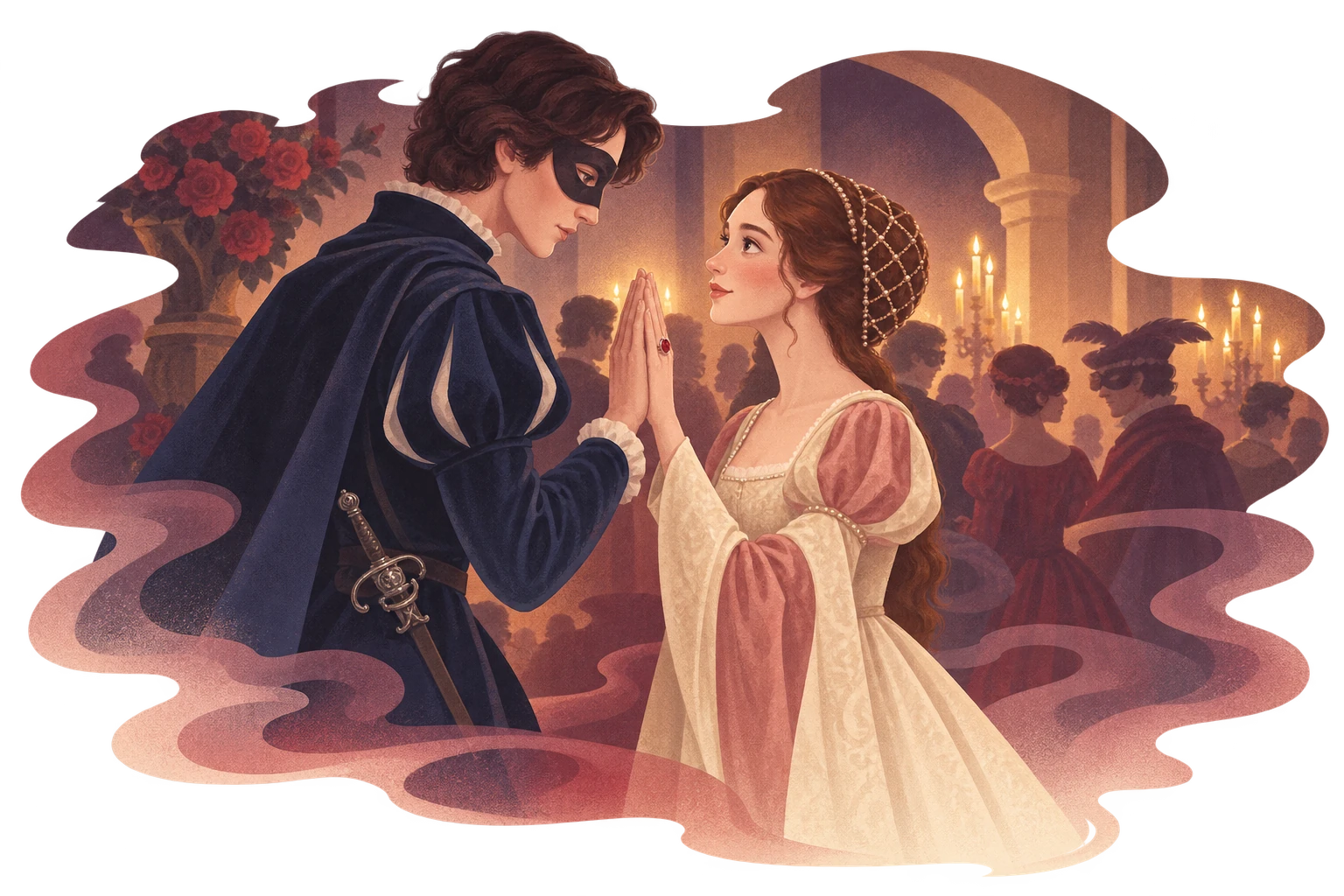
Shakespeare makes the love story inseparable from the violence surrounding it. The opening street fight in Act 1, Scene 1 establishes that the feud affects the whole city, not just the two households. When Romeo and Juliet meet at the Capulet feast in Act 1, Scene 5, their first conversation forms a shared sonnet: their language briefly creates harmony within that divided world.
The play also questions the speed of their passion. Friar Laurence warns:
‘These violent delights have violent ends’ (Act 2, Scene 6).
His words connect intense pleasure with destruction, anticipating the tragic outcome without making love itself the only cause.
By Act 5, Scene 3, failed communication, family hostility and desperate decisions have brought both lovers to their deaths. Their families finally reconcile. For an essay, this gives you a useful argument: Shakespeare transforms an inherited love story into a tragedy about both private choices and a community’s failure to control hatred.
Questions
Is Romeo and Juliet a true story?
Romeo and Juliet is not an established account of real lovers. Shakespeare adapted an existing literary story set in Italy. Its convincing emotions and social conflicts do not mean that its characters and events should be treated as documented history.
Did Arthur Brooke write Romeo and Juliet?
Arthur Brooke wrote The Tragical History of Romeus and Juliet, a narrative poem published in 1562. William Shakespeare wrote the play Romeo and Juliet. Brooke’s poem was Shakespeare’s main source, so both writers belong to the story’s history, but they wrote different works.
Why is Romeo and Juliet called a tragedy?
It is a tragedy because the central relationship ends in catastrophe: both Romeo and Juliet die in Act 5, Scene 3. Their deaths result from a combination of family hatred, violence, secrecy, failed communication and their own desperate choices.
Where is Romeo and Juliet set?
The play is set mainly in Verona, Italy, where the Montagues and Capulets are feuding. Romeo goes to Mantua after his banishment. The Italian setting should not be confused with the play’s origin: Shakespeare wrote it in English for the English theatre.