How Is Ambition Presented in Macbeth?
Shakespeare presents ambition in Macbeth as a powerful desire that becomes destructive when it overrides conscience and loyalty. Encouraged by the witches and Lady Macbeth, Macbeth chooses murder to gain the crown, then further violence to protect it. His rise and collapse show how unchecked ambition destroys individuals and damages an entire country.
Ambition in Macbeth: desire and choice
Macbeth begins as a successful warrior whose courage serves Scotland. His promotion to Thane of Cawdor shows that advancement can come through loyal service. Shakespeare therefore distinguishes honourable achievement from the willingness to gain power at any cost.
The witches awaken the possibility of kingship, but they do not tell Macbeth to murder Duncan. At first, he considers leaving events alone: 'If chance will have me king, why, chance may crown me, / Without my stir' (Act 1, Scene 3). This matters because it establishes an alternative to violence.
However, when Duncan names Malcolm his heir, Macbeth sees the succession as an obstacle. He asks, 'Stars, hide your fires; / Let not light see my black and deep desires' (Act 1, Scene 4). The contrast between light and darkness presents his ambition as something he already knows must be concealed.
Shakespeare makes Macbeth responsible for his response to temptation: prophecy offers a possibility, while Macbeth supplies the murderous interpretation.
‘Vaulting ambition’ and Macbeth's tragic flaw
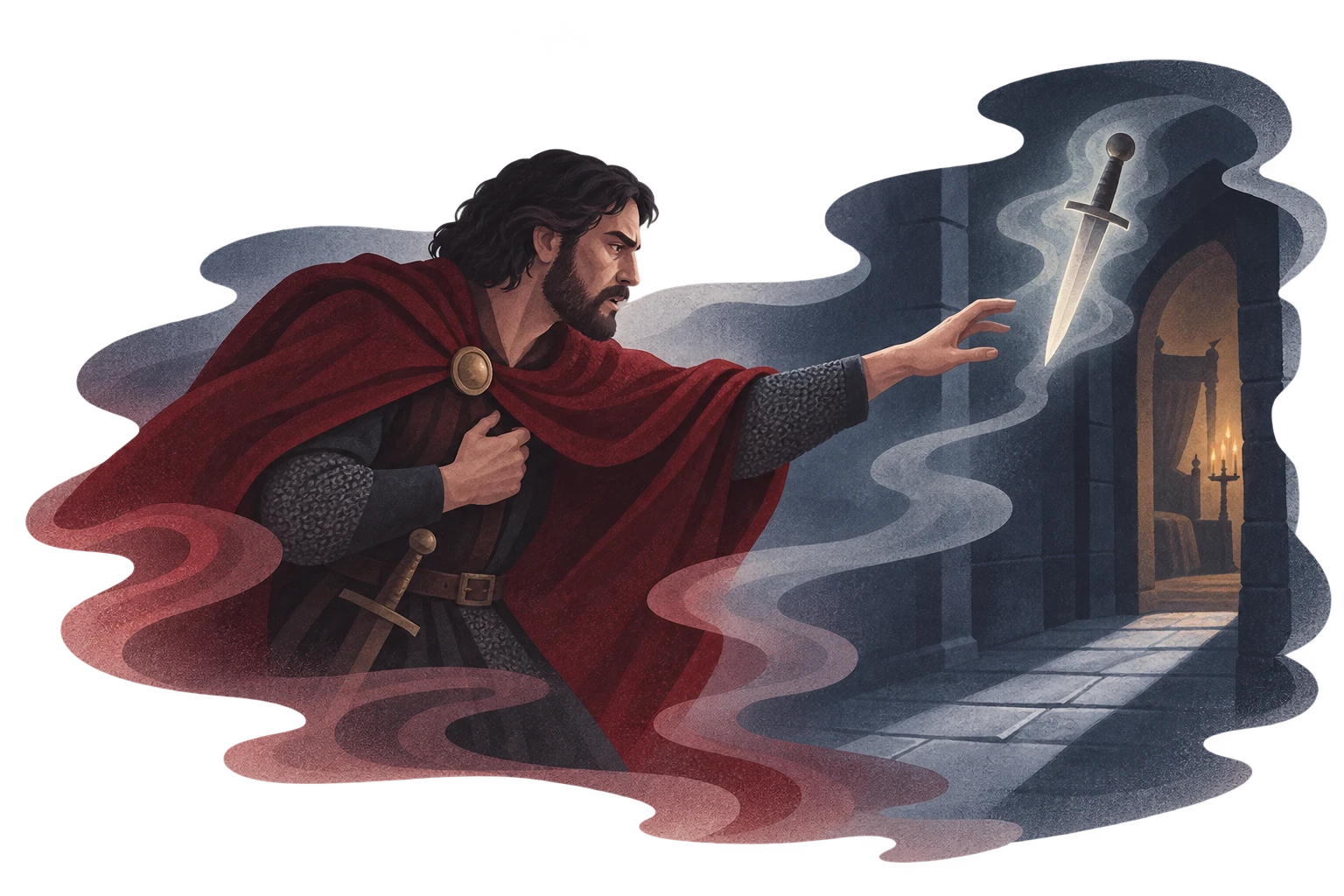
Macbeth's clearest assessment of his own motivation comes before Duncan's murder:
'I have no spur / To prick the sides of my intent, but only / Vaulting ambition, which o'erleaps itself / And falls on the other' (Act 1, Scene 7).
The riding imagery makes ambition seem energetic but dangerously uncontrolled. Macbeth imagines an attempt to rise that overshoots and ends in a fall. The image anticipates the structure of his tragedy: gaining the crown begins the process that destroys him.
The word 'only' is especially revealing. Macbeth recognises that he has no just reason to kill Duncan. Duncan is his king, his relative and his guest; Macbeth also acknowledges his virtues as a ruler. Ambition must overcome several clearly understood moral obligations.
This makes Macbeth's ambition a tragic flaw rather than an innocent misunderstanding. He can reason against the crime and initially decides not to proceed. His later decision is therefore particularly disturbing: he knowingly sacrifices conscience to advancement. Shakespeare presents his downfall as the consequence of choices, not simply bad luck.
Lady Macbeth turns ambition into action
Lady Macbeth does not create her husband's ambition. She recognises a desire already present, telling him in his absence, 'Thou wouldst be great; / Art not without ambition, but without / The illness should attend it' (Act 1, Scene 5). Her judgement separates wanting power from being willing to commit the evil she believes necessary to obtain it.
She then pressures Macbeth by linking murder with masculinity: 'When you durst do it, then you were a man' (Act 1, Scene 7). This turns his hesitation into an apparent failure of courage. Shakespeare exposes a dangerous confusion between manliness and violence, through which moral restraint can be dismissed as weakness.
However, her influence does not remove Macbeth's responsibility. He agrees to the plot and later arranges Banquo's murder without sharing the details with her.
Their changing relationship also reveals ambition's failure to bring fulfilment. Having helped secure the crown, Lady Macbeth admits, 'Nought's had, all's spent, / Where our desire is got without content' (Act 3, Scene 2). Achievement has brought neither happiness nor peace.
From gaining power to protecting it
After Duncan's murder, ambition changes form. Macbeth no longer needs to become king; he needs to feel secure as king. He declares, 'To be thus is nothing, / But to be safely thus' (Act 3, Scene 1). The repetition of 'thus' reduces his great achievement to a condition that means nothing without safety.
The witches' prediction that Banquo's descendants will rule makes Macbeth fear that his crimes have benefited another family. His description of a 'fruitless crown' and a 'barren sceptre' presents power without a lasting dynasty as empty (Act 3, Scene 1). Ambition cannot be satisfied because possessing the crown produces further demands.
Macbeth consequently orders the attack on Banquo and Fleance, then later the slaughter of Macduff's household. Violence becomes a means of protecting earlier violence.
Shakespeare also widens the consequences beyond Macbeth's private guilt. Scotland suffers under a ruler who treats possible threats as targets for destruction. Unchecked ambition becomes tyranny: the desire to secure one man's position takes priority over the lives and welfare of his subjects.
Downfall, emptiness and an essay argument
By the final act, Macbeth has gained the title he wanted but lost much of what could make life valuable. He recognises that he cannot expect 'honour, love, obedience, troops of friends' in old age (Act 5, Scene 3). His position commands outward service rather than genuine loyalty.
After hearing of Lady Macbeth's death, he describes life as 'a tale / Told by an idiot, full of sound and fury, / Signifying nothing' (Act 5, Scene 5). This is Macbeth's despairing perspective, not necessarily Shakespeare's judgement on all human life. Within his tragedy, however, it exposes the emptiness of advancement purchased through betrayal and murder.
For an essay, trace a development, rather than treating ambition as an unchanged characteristic:
- Initially, Macbeth imagines kingship but recognises moral limits.
- He chooses to cross those limits, encouraged by Lady Macbeth.
- Once king, insecurity turns ambition into escalating tyranny.
- Finally, power leaves him isolated and unable to find meaning.
A strong central argument is that Shakespeare condemns ambition severed from conscience and public duty, rather than suggesting that every desire to achieve is wrong.
Questions
What is the best quotation about ambition in Macbeth?
'Vaulting ambition, which o'erleaps itself / And falls on the other' (Act 1, Scene 7) is especially useful. Its riding imagery presents ambition as excessive and self-defeating. Macbeth identifies his own motive before committing murder, so the quotation supports analysis of both his responsibility and his eventual downfall.
Do the witches cause Macbeth's ambition?
The witches encourage Macbeth to imagine becoming king, but they neither order Duncan's murder nor force Macbeth to act. His response to their prophecy reveals how strongly the possibility attracts him. Shakespeare presents supernatural temptation alongside personal responsibility: Macbeth repeatedly chooses violent ways of pursuing and protecting power.
Is Lady Macbeth more ambitious than Macbeth?
Early in the play, Lady Macbeth appears more determined to act, while Macbeth is more troubled by conscience. However, hesitation does not mean he lacks ambition. Later, he plans further murders independently, while she finds their success empty. Their changing behaviour makes a simple ranking of their ambition misleading.
How can I write a strong essay about ambition in Macbeth?
Build an argument about how ambition changes Macbeth, using moments from across the play. Analyse specific language, such as the imagery of 'Vaulting ambition' (Act 1, Scene 7), and connect his private choices to Scotland's suffering. Distinguish the witches' and Lady Macbeth's influence from Macbeth's own responsibility.