What Type of Play Is Macbeth?
Macbeth is a Shakespearean tragedy: a play in which a high-ranking central character falls from greatness and dies. Macbeth’s ambition leads him to murder King Duncan, seize the Scottish throne and become a tyrant. Although the play includes history, supernatural events and moments of comedy, its central story is tragic.
Tragedy, history or comedy?
The table compares tragedy, history and comedy through their roles in Macbeth. Tragedy describes the play’s overall movement; historical material provides its political setting, while the Porter supplies a local comic interruption.
What type of play is Macbeth? A Shakespearean tragedy
Macbeth belongs to the genre of tragedy, rather than comedy or history. Its central movement is a reversal of fortune: Macbeth begins as an honoured warrior and ends as an isolated ruler killed by Macduff.
At first, Macbeth’s courage serves Scotland. The Captain calls him ‘brave Macbeth’ (Act 1, Scene 2), establishing the reputation he will destroy. After hearing the witches’ predictions, he begins to imagine becoming king. He then murders Duncan, whose trust makes the betrayal especially serious.
The tragedy extends beyond Macbeth’s own suffering. Banquo is murdered, Macduff’s household is attacked, Lady Macbeth dies, and Scotland suffers under violent rule. Macbeth’s attempt to secure greatness therefore brings misery to both his family and his country.
The ending combines personal catastrophe with political recovery. Macbeth dies and Malcolm takes power, offering Scotland the prospect of legitimate government. This restoration does not make the play a comedy: the deaths and suffering cannot be undone. Instead, it shows the terrible cost of removing a tyrant and repairing the disorder he has created.
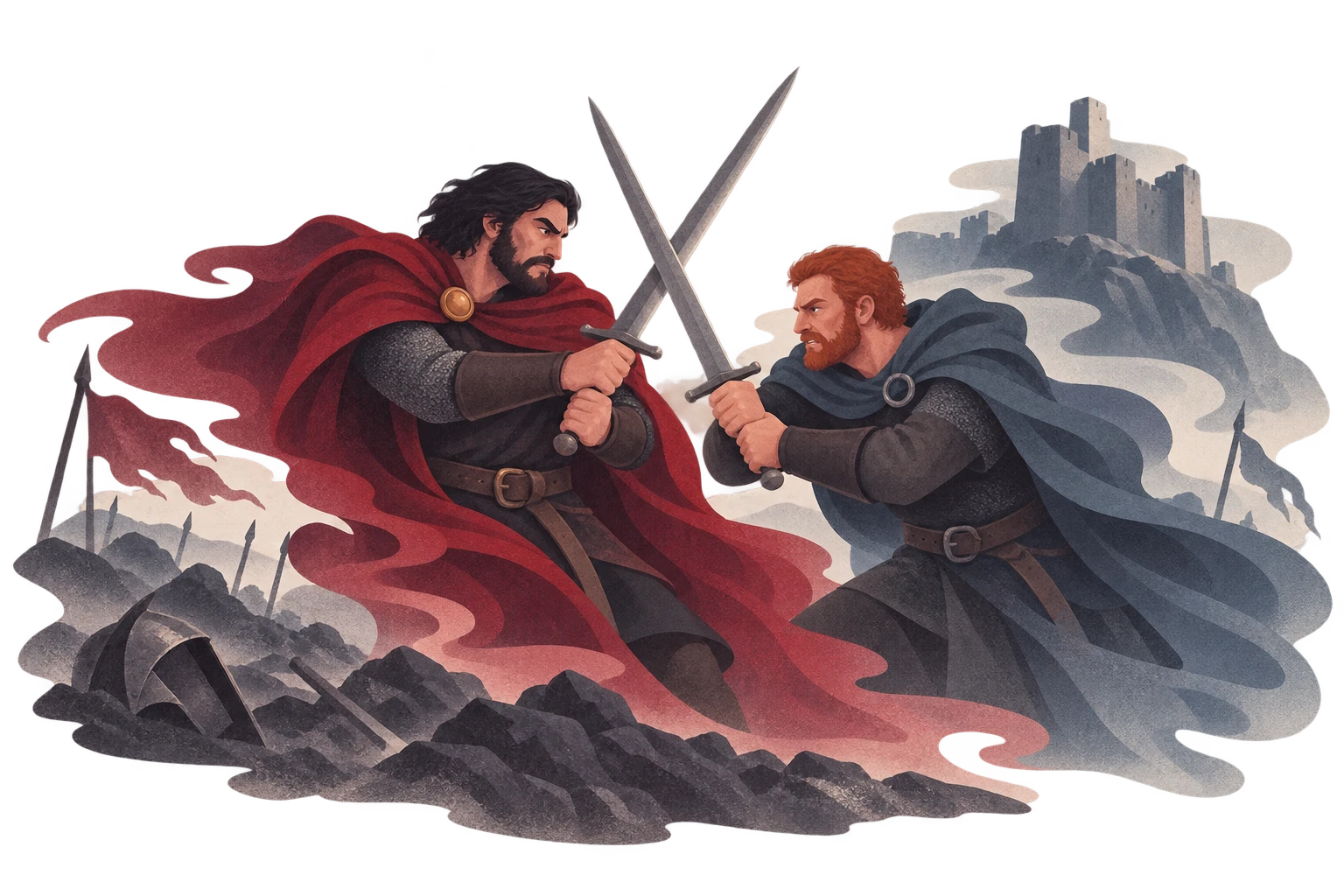
Macbeth as a tragic hero
Calling Macbeth a tragic hero does not mean that he remains morally good. Here, ‘hero’ means the central figure whose actions and downfall shape the tragedy. Shakespeare first gives Macbeth status, courage and a capacity for moral reflection, making his later transformation more disturbing.
Macbeth understands that murdering Duncan is wrong. In Act 1, Scene 7, he recognises his duties as Duncan’s relative, subject and host. He identifies his motive as ‘vaulting ambition’ (Act 1, Scene 7). The image suggests a desire that overreaches itself: the attempt to rise becomes the cause of a fall.
Ambition is therefore often described as Macbeth’s tragic flaw, but this should not reduce the play to a simple formula. Lady Macbeth’s persuasion, the witches’ predictions and Macbeth’s increasingly reckless confidence all contribute to his downfall. Crucially, he repeatedly chooses violence.
The witches do not order him to murder Duncan. Later, Macbeth arranges further killings to defend his crown. His tragedy arises partly from the gap between knowing what is right and choosing what serves his ambition.
History, the supernatural and moments of comedy
Macbeth draws on Scottish history, but its historical setting does not make it a history play in the usual Shakespearean classification. It is conventionally grouped with Shakespeare’s tragedies, alongside plays such as Hamlet, Othello and King Lear. Its main focus is Macbeth’s destructive choices and downfall, rather than simply recording a reign.
The play also contains supernatural elements. The witches predict Macbeth’s rise, Banquo’s ghost disrupts the banquet, and the apparitions encourage Macbeth’s dangerous confidence. These features create fear and uncertainty, but they work within the tragedy rather than replacing its genre. Prophecy matters because of how Macbeth interprets and acts upon it.
Nor does every scene need to be solemn. The Porter’s drunken speech in Act 2, Scene 3 provides comic relief immediately after Duncan’s murder. Its humour briefly changes the tone without changing the play’s overall tragic direction.
For an exam, a precise opening would be: Shakespeare presents Macbeth as a tragedy in which a celebrated warrior’s ambition turns him into a tyrant and brings about his destruction. Then support that claim with a specific choice, consequence and quotation.
Questions
Is Macbeth a tragedy or a history play?
Macbeth is classified as a tragedy. Although it draws on Scottish history and concerns kingship, its central pattern is the rise and destruction of Macbeth through his own actions. A historical subject does not automatically make a Shakespeare play a history play.
What is Macbeth’s tragic flaw?
Macbeth’s chief tragic flaw is unchecked ambition: he wants the crown enough to violate his conscience and murder Duncan. His reference to ‘vaulting ambition’ (Act 1, Scene 7) identifies this motive. However, his downfall also involves fear, overconfidence and repeated decisions to use violence.
Is Macbeth a supernatural play?
Macbeth is a tragedy with important supernatural elements. The witches, apparitions and Banquo’s ghost shape its atmosphere and action. However, supernatural influence does not remove Macbeth’s responsibility: the witches predict kingship, but Macbeth chooses murder as his way of obtaining it.
What does it mean to call Macbeth a Jacobean tragedy?
‘Jacobean’ identifies the period associated with the reign of James I of England; ‘tragedy’ identifies the play’s genre. The terms describe different things and can be used together. Calling Macbeth a Jacobean tragedy places its story of ambition and downfall within its theatrical and political context.