How Does Macbeth Change Throughout the Play?
Macbeth changes from a respected, loyal warrior into a guilty murderer, then a ruthless and isolated tyrant. Ambition leads him to kill Duncan; fear of losing power drives further murders. By the end, he finds life meaningless but still fights. His courage remains, while his loyalty and moral restraint collapse.
How does Macbeth change throughout the play?
Macbeth’s transformation begins with a contrast: the qualities that make him valuable to Scotland later make him dangerous to it. In Act 1, Scene 2, the Captain calls him ‘brave Macbeth’, celebrating his violence in defence of Duncan. He begins as a successful soldier, not a helpless or naturally cowardly man.
However, Shakespeare reveals ambition beneath this public loyalty. After the witches predict his kingship and Duncan names Malcolm his heir, Macbeth refers to his ‘black and deep desires’ (Act 1, Scene 4). The darkness imagery shows that he already recognises something shameful in what he wants.
His conscience initially resists. In Act 1, Scene 7, he declares, ‘We will proceed no further in this business’. He understands his duties as Duncan’s subject, kinsman and host. Lady Macbeth’s attack on his courage helps overturn this decision, but the ambition is already his. His first major change is choosing personal advancement over obligations he fully understands.
After Duncan’s murder: guilt overwhelms confidence
Killing Duncan does not immediately turn Macbeth into an unfeeling villain. Instead, Act 2 exposes how powerfully his conscience reacts. Before the murder, the imagined dagger draws his attention towards Duncan’s chamber; afterwards, his speech becomes anxious and disturbed.
In Act 2, Scene 2, Macbeth asks whether ‘all great Neptune’s ocean’ could wash the blood from his hand. The exaggerated scale makes his guilt seem larger than the natural world. Blood is now more than evidence of physical violence: it represents a moral stain he cannot escape.
His relationship with Lady Macbeth also reveals his instability. When he refuses to return the daggers, she takes charge of completing the cover-up. The celebrated battlefield warrior cannot face the scene of his secret crime.
This is an important distinction for analysis: Macbeth becomes more violent before he becomes emotionally hardened. His distress proves that he understands the horror of what he has done. Later murders develop partly from his determination to protect the crown gained through that first crime.
As king: insecurity turns into independent violence
Once Macbeth becomes king, ambition changes into anxiety about keeping power. In Act 3, Scene 1, he admits, ‘To be thus is nothing, but to be safely thus’. Kingship alone cannot satisfy him because he fears threats to his position, especially the prophecy that Banquo’s descendants will become kings.
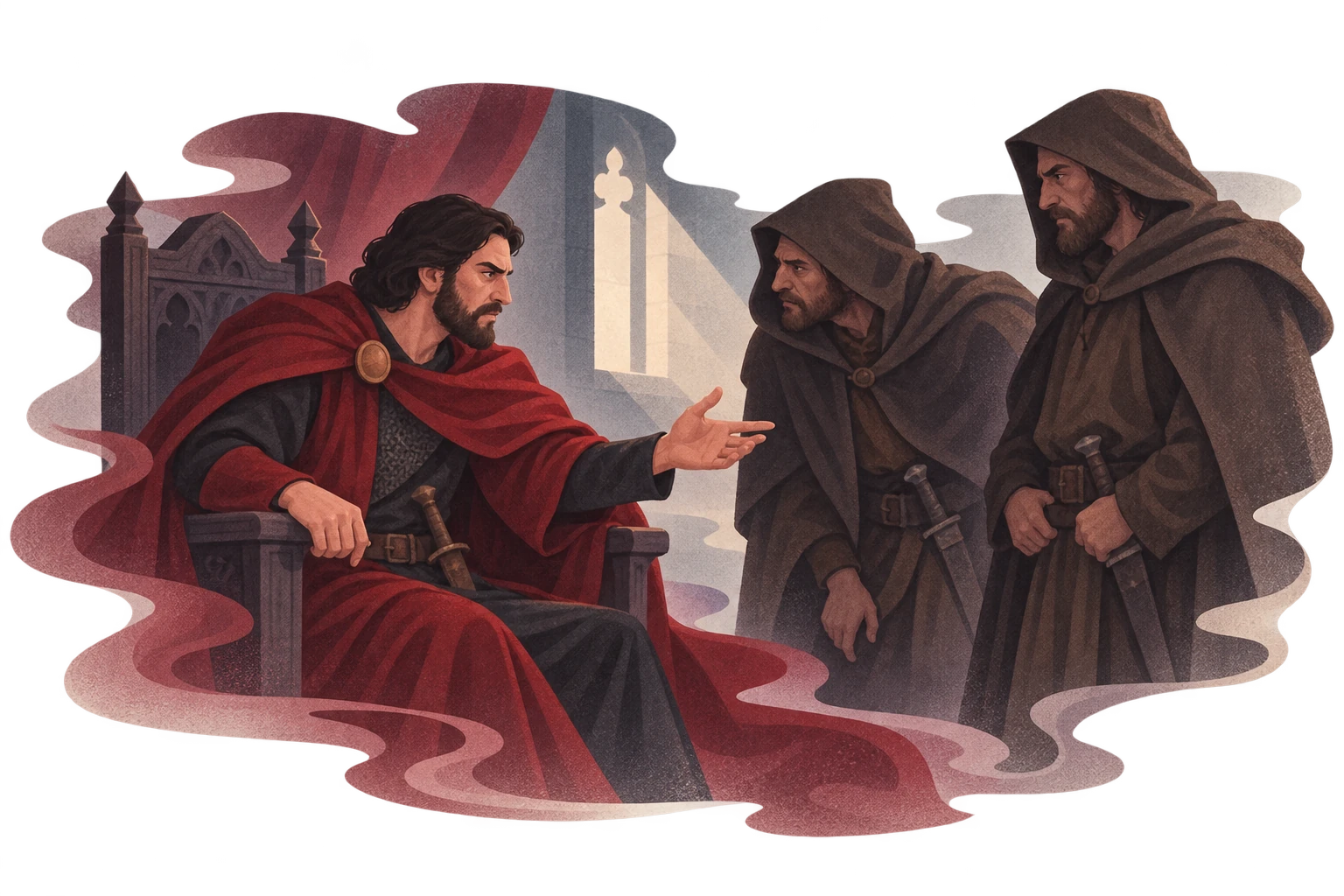
His decision to arrange Banquo’s murder marks a significant shift. Before Duncan’s murder, Lady Macbeth had to challenge his hesitation. Now he hires murderers himself and conceals the plan from her, telling her to ‘Be innocent of the knowledge’ (Act 3, Scene 2). He becomes the organiser of violence rather than the reluctant partner.
Yet his growing ruthlessness does not bring psychological control. At the banquet, his terrified response to Banquo’s ghost publicly disrupts his authority. Shakespeare places the confident planner beside the frightened man who cannot master his own reactions.
By Act 3, Scene 4, Macbeth describes himself as ‘in blood’. He increasingly treats further violence as the practical consequence of earlier violence, rather than reconsidering the choices that brought him there.
Act 4: fear becomes tyranny
Macbeth’s return to the witches shows that possessing political power has not made him secure. He seeks certainty from supernatural predictions rather than governing through trust or justice. The apparitions encourage confidence, but their promises depend on meanings he does not fully understand.
After hearing that Macduff has fled to England, Macbeth resolves to attack his household. In Act 4, Scene 1, he names the intended victims as ‘His wife, his babes’. This is a further moral deterioration: he now orders the killing of vulnerable people who pose no direct military threat.
The contrast with Duncan’s murder is striking. Then, Macbeth debated his obligations and imagined the consequences. Now he tries to remove the gap between impulse and action. Violence has become his habitual response to insecurity.
Shakespeare also widens the consequences beyond Macbeth’s private suffering. The attack on Macduff’s family turns his personal fears into devastation for others. His change into a tyrant is measured not simply by how he feels, but by what Scotland suffers under his rule.
The ending: emotional exhaustion and defiant courage
In Act 5, Macbeth is increasingly isolated as nobles abandon him and enemy forces approach. He still relies on the apparitions’ promises, but his apparent confidence coexists with exhaustion. In Act 5, Scene 5, he says he has ‘almost forgot the taste of fears’, suggesting that repeated horrors have dulled his responses.
News of Lady Macbeth’s death prompts a bleak reflection on existence. His description of life as ‘signifying nothing’ (Act 5, Scene 5) shows how empty his pursuit of greatness has become. He has gained the crown but lost the relationships, security and purpose that might have made power worthwhile.
Nevertheless, the ending does not erase his original courage. When Macduff reveals that he was delivered from his mother’s womb before the natural time, Macbeth recognises the witches’ deception. He briefly refuses combat, then declares, ‘I will not yield’ (Act 5, Scene 8).
Macbeth’s bravery survives his moral collapse. This makes his ending tragic rather than a simple reversal from courage to cowardice: the warrior’s determination remains, but it now serves a ruined cause.
Questions
What is the main turning point in Macbeth’s character?
Duncan’s murder is the central turning point because Macbeth knowingly betrays his king and turns ambition into action. However, arranging Banquo’s murder marks another crucial change: he no longer needs Lady Macbeth to push him towards violence and begins directing further crimes independently.
Does Lady Macbeth cause Macbeth to change?
Lady Macbeth helps persuade him to murder Duncan by questioning his courage and masculinity. However, Macbeth already has ambitions of his own, and he later plans violence without consulting her. Shakespeare presents her as an important influence, not the sole cause of his choices.
Does Macbeth stop feeling guilty?
Macbeth becomes more hardened, but he does not simply stop feeling disturbed. Banquo’s ghost exposes his continuing terror in Act 3, Scene 4. Later, he responds increasingly through violence and emotional numbness. His changing reactions suggest damage and suppression rather than genuine peace of mind.
How should I structure an essay on Macbeth’s change?
Build a chronological argument: loyal warrior with hidden ambition; guilty murderer; insecure king; ruthless tyrant; exhausted but defiant fighter. In each paragraph, analyse a short quotation and explain what changes. For a stronger argument, also track what remains: his courage, imagination and vulnerability to fear.