Is Macbeth Based on a True Story?
Yes, Macbeth is loosely based on a true story: Macbeth was a real Scottish king who ruled from 1040 to 1057 after defeating Duncan in battle. However, Shakespeare adapted historical chronicles rather than producing accurate history. Duncan’s murder in Macbeth’s castle, the witches’ prophecies and much of the personal drama are not established historical facts.
How Macbeth is based on a true story
The historical Macbeth ruled Scotland in the eleventh century. He became king in 1040 after Duncan I was killed in battle against his forces, and he ruled until 1057. These names and the struggle for the Scottish crown provide the historical foundation of Shakespeare’s tragedy.
The differences matter just as much. The real Duncan was a relatively young man, not the elderly, fatherly figure suggested by Shakespeare’s presentation. His death was a battlefield event, not a secret assassination while staying as Macbeth’s guest. Macbeth’s seventeen-year reign also differs from the play’s concentrated movement from murder to fear, rebellion and defeat.
Historical evidence for this period is limited, so it would be misleading to replace Shakespeare’s villain with an equally certain portrait of a wholly benevolent king. The sound conclusion is narrower: a real king and a real conflict lie behind the play, but its account of motives, conversations and private crimes is drama, not a historical record.
Shakespeare’s source: Holinshed’s Chronicles
Shakespeare’s main narrative source was Holinshed’s Chronicles, a collection of British histories. He drew on its account of Macbeth, but also borrowed material from another Scottish story: the murder of King Duff by Donwald. That story supplied important elements of the treacherous killing of a royal guest.
This means there are several layers between the historical events and the play: medieval accounts, later chronicles and Shakespeare’s dramatic adaptation. A detail appearing in a chronicle is not automatically a verified fact. Supernatural stories and politically useful genealogies could become part of historical writing.
Banquo is an important example. There is no secure historical evidence establishing him as the real Macbeth’s fellow general. In Holinshed’s narrative, Banquo is involved in the conspiracy against Duncan; Shakespeare instead makes him resist the witches’ temptation and become Macbeth’s victim. The change gives Macbeth a moral contrast and makes his betrayal of his friend more disturbing.
What Shakespeare changes for the tragedy
The most important alteration is the way Duncan dies. In Act 1, Scene 7, Macbeth recognises that Duncan is under his protection in ‘double trust’: Macbeth is both his subject and his host. Turning a battlefield death into the murder of a sleeping guest makes the seizure of power a deeply personal betrayal.
Shakespeare also gives the crime a psychological cause. Macbeth identifies his own ‘Vaulting ambition’ in Act 1, Scene 7. The audience watches him choose violence despite understanding why it is wrong. This is an exploration of ambition and moral responsibility, not documented evidence about the historical king’s thoughts.
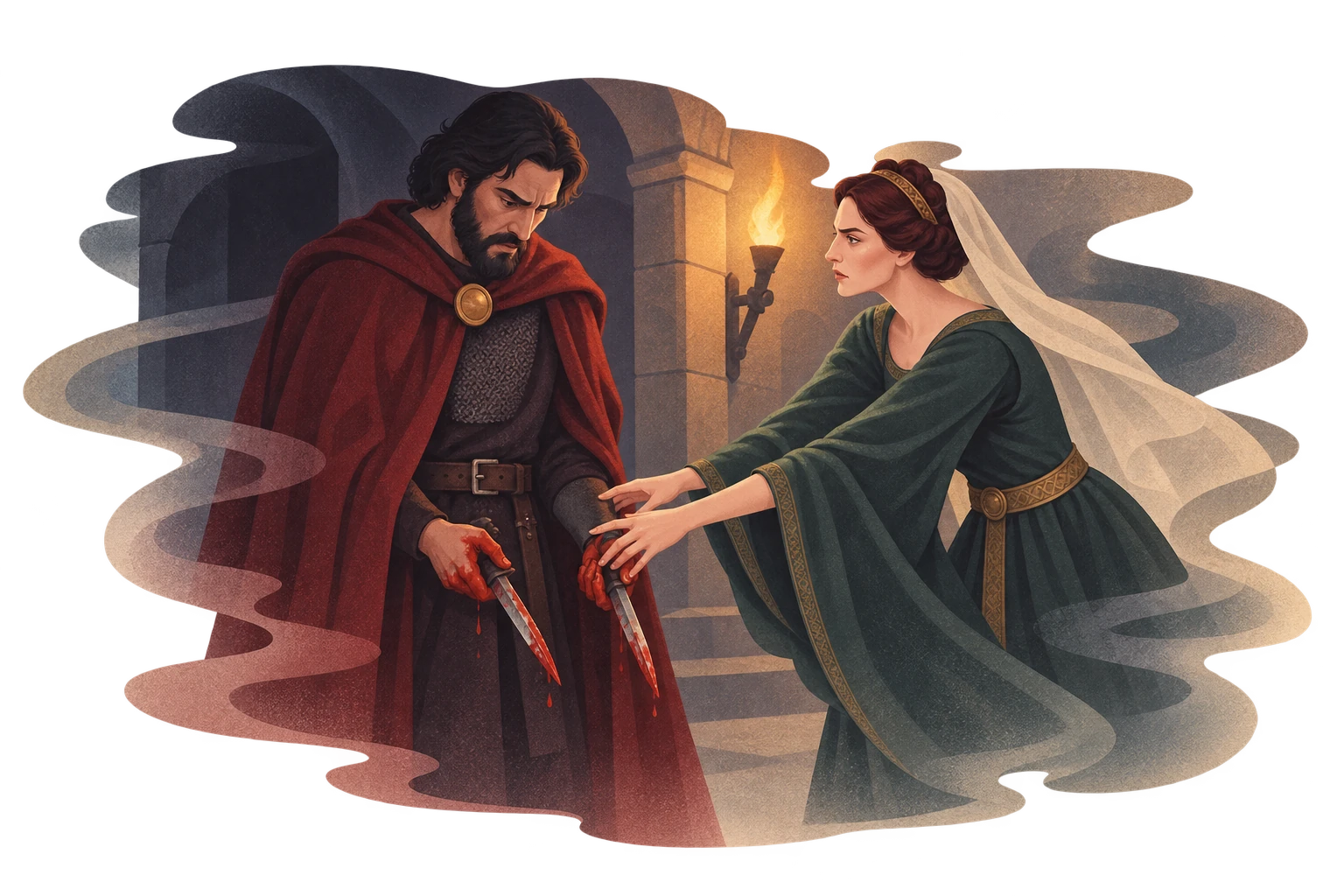
Likewise, Lady Macbeth’s persuasion, Banquo’s ghost, the dagger vision and the sleepwalking scene should not be treated as biographical facts. The supernatural warnings create dramatic uncertainty, while blood and sleeplessness expose guilt. These elements make the story a tragedy about what gaining power can cost, rather than simply a sequence of royal deaths.
James I, Banquo and the meaning of kingship
The play is usually dated to around 1606, during the reign of James VI of Scotland, who had also become James I of England in 1603. Its Scottish setting, threatened monarchy and supernatural elements would therefore have had particular relevance to Shakespeare’s audience.
James’s family traced its ancestry to Banquo through Fleance. This was a dynastic tradition, not a securely established historical genealogy. In Act 1, Scene 3, the witches tell Banquo, ‘Thou shalt get kings, though thou be none’. That promise connects the play’s struggle over succession with a royal ancestry claimed in Shakespeare’s own time.
James also took a strong interest in witchcraft. These connections help explain why Shakespeare’s treatment of Scottish history mattered, but they do not prove that every detail was designed simply to flatter the king.
For an essay, connect context to a specific dramatic choice: Shakespeare turns contested succession into a contrast between tyranny and legitimate kingship, while showing how Macbeth’s desire to control the future destroys him.
Questions
Was Lady Macbeth a real person?
The historical Macbeth’s wife was called Gruoch, but little is known about her life. Shakespeare’s Lady Macbeth is not a reliable portrait of her. There is no secure evidence that Gruoch persuaded Macbeth to murder Duncan or experienced the guilt and sleepwalking shown in the play.
How did the real Macbeth die?
The historical Macbeth was killed at the Battle of Lumphanan in 1057, fighting forces led by Duncan’s son Malcolm. The play instead gives him a final duel with Macduff in Act 5, Scene 8. Macduff’s revelation about his birth belongs to the dramatic story, not established history.
Did Malcolm become king immediately after Macbeth?
Not historically. Macbeth was succeeded by his stepson Lulach, who ruled briefly before Malcolm became king in 1058. Shakespeare leaves out Lulach and ends with Malcolm’s victory, giving the tragedy a clearer conclusion in which Macbeth’s defeat promises the restoration of political order.
Were the witches in Macbeth real?
There is no historical evidence that witches predicted Macbeth’s rise to the throne. Shakespeare developed supernatural material found in his chronicle source. In the play, their predictions tempt Macbeth and mislead him, but they do not remove his responsibility for choosing murder.