What Era Was Macbeth Written In?
Macbeth was written in the Jacobean era, probably around 1606, during the reign of James I of England, who was also James VI of Scotland. It belongs to the wider English Renaissance. Although Shakespeare wrote it in the early seventeenth century, its story is set in eleventh-century Scotland.
What era was Macbeth written in?
Macbeth is a Jacobean tragedy: it was probably written around 1606, during the reign of James I of England. The Jacobean period runs from 1603, when James succeeded Elizabeth I, to his death in 1625. The name comes from Jacobus, the Latin form of James.
Shakespeare's career crossed two reigns, which can cause confusion. He wrote under both Elizabeth I and James I, but Macbeth belongs to the later, Jacobean part of his career, not the Elizabethan period. Both periods fall within the broader English Renaissance and early modern era.
The date 1606 is an estimate, not a confirmed composition date. No surviving manuscript tells us exactly when Shakespeare wrote the play. Its themes and topical references help scholars place it around this time. A recorded performance dates from 1611, while the play first appeared in print in the First Folio of 1623. Writing, performance and publication are therefore separate dates.
English and Scottish reigns around Macbeth
The table compares the English Elizabethan and Jacobean periods with James VI’s Scottish reign, using the dates supplied in the article rather than attempting a complete list of historical eras. Separate date buttons distinguish Macbeth’s estimated composition around 1606, recorded performance in 1611 and first publication in 1623.
James I, witchcraft and the fear of treason
The Jacobean context helps explain why Macbeth brings together Scottish history, witchcraft and threats to a king. James was already James VI of Scotland when he became James I of England in 1603. He had a strong interest in witchcraft and published Daemonologie in 1597.
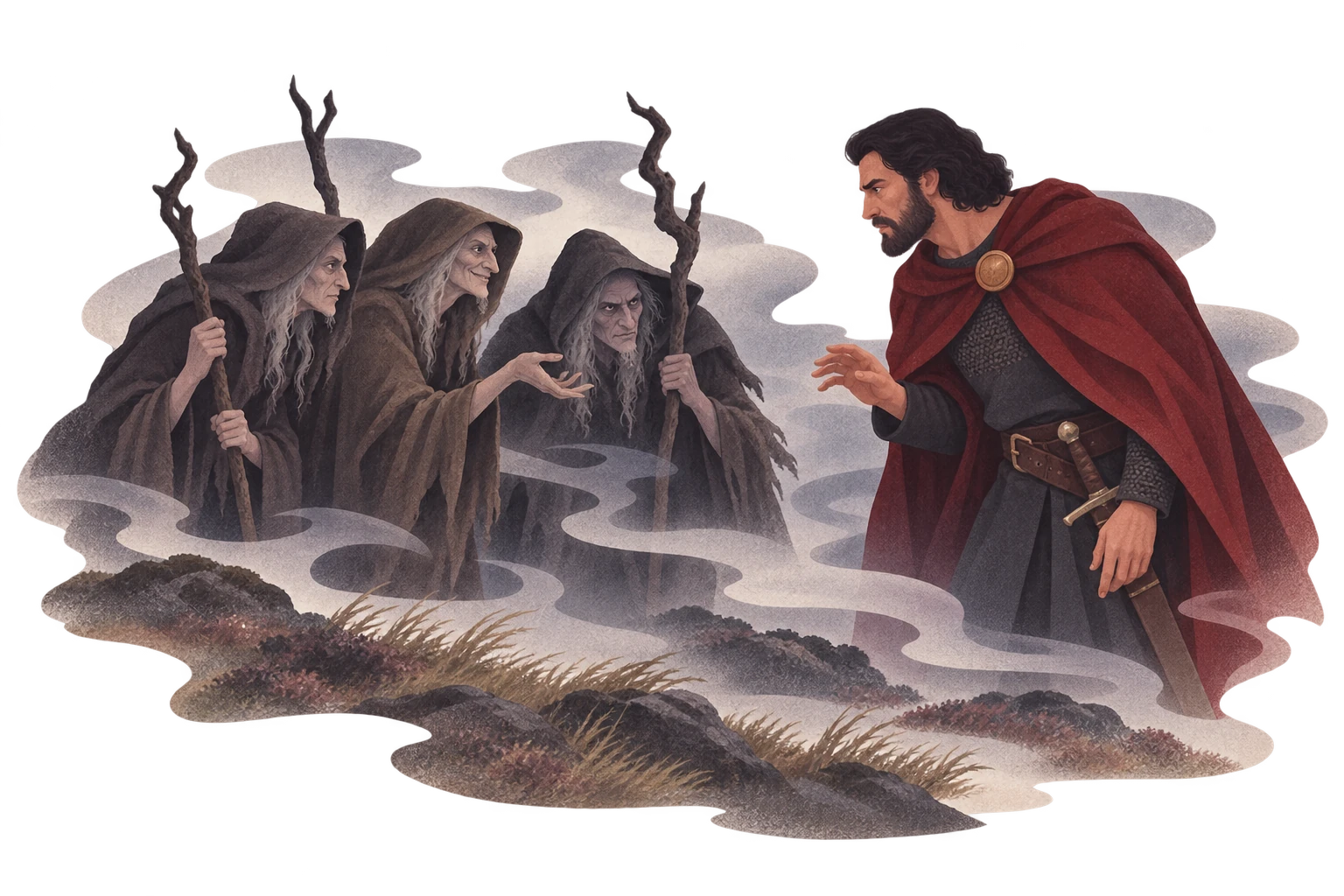
The witches exploit Macbeth's ambition, but their predictions do not remove his responsibility. Banquo warns that the 'instruments of darkness' may tell truths in order to betray people (Act 1, Scene 3). This makes the supernatural a source of temptation and deception, not a simple explanation for everything Macbeth does.
The Gunpowder Plot of 1605, an attempt to kill James and destroy Parliament, also provides relevant context for the play's concern with treason. After Duncan's murder, Macduff describes his body as 'the Lord's anointed temple' (Act 2, Scene 3), presenting kingship as sacred.
These connections make the play topical for a Jacobean audience. They do not prove that Shakespeare wrote it solely to flatter James or respond to one event.
The writing era versus the historical setting
The most important distinction is between when Shakespeare wrote the play and when its events take place. Shakespeare wrote Macbeth in early seventeenth-century England, but the action is set in eleventh-century Scotland. The historical Macbeth ruled Scotland from 1040 to 1057.
Shakespeare drew on historical chronicles, particularly Holinshed's Chronicles, but his play is not a reliable biography. It reshapes historical material into a tragedy about ambition, murder and the abuse of power. Its medieval setting allows Shakespeare to explore concerns that also mattered to his Jacobean audience: rightful succession, loyalty, rebellion and the responsibilities of rulers.
In an essay, connect context to a specific dramatic moment rather than adding it as an isolated fact. For example, Duncan's murder violates Macbeth's duties as subject, relative and host, which Macbeth himself recognises in Act 1, Scene 7. You can then explain how this betrayal would resonate in a society concerned with royal authority. Avoid claiming that every Jacobean spectator held exactly the same beliefs.
Questions
Is Macbeth Elizabethan or Jacobean?
Macbeth is Jacobean because it was probably written around 1606, after James I became king in 1603. Shakespeare himself is associated with both the Elizabethan and Jacobean periods, but that does not make all his plays Elizabethan.
Was Macbeth written during the Renaissance?
Yes. Macbeth belongs to the English Renaissance, a broad cultural period that includes both Elizabethan and Jacobean literature. Jacobean is the more precise answer when identifying the reign during which Shakespeare probably wrote the play.
When was Macbeth first performed?
The earliest surviving eyewitness account records a performance at the Globe in 1611. The play was probably written around 1606 and may have been performed before 1611, so the earliest documented performance should not be treated as its confirmed premiere.
Why is King James important to Macbeth?
James ruled both Scotland and England, took an interest in witchcraft, and was believed to descend from Banquo. These connections make the play's Scottish setting, witches and prophecies about Banquo's descendants particularly relevant to his reign, without proving that every detail was designed to please him.