How Does Shakespeare Present the Supernatural in Macbeth?
Shakespeare presents the supernatural in Macbeth as a deceptive, unsettling influence that tempts Macbeth without removing his responsibility. The witches exploit his ambition through ambiguous prophecies, while visions expose his fear and guilt. Supernatural events also connect Duncan’s murder with disorder in nature, making Macbeth’s crimes seem violations of a wider moral order.
The supernatural in Macbeth: confusion from the opening
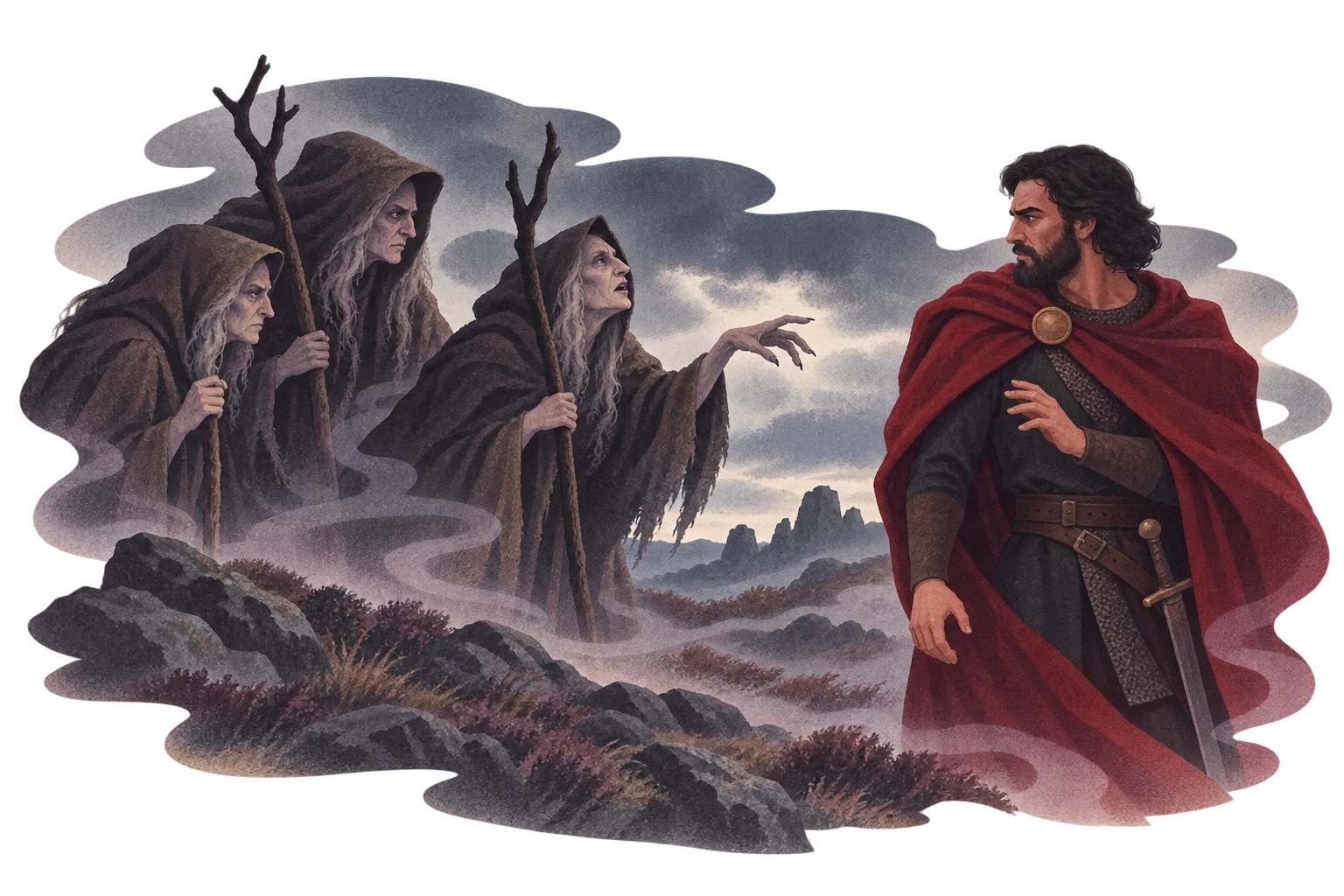
Shakespeare introduces the supernatural before introducing Macbeth himself. In Act 1, Scene 1, thunder and lightning accompany the witches, immediately creating an atmosphere of danger and uncertainty. Their opening discussion establishes that they intend to meet Macbeth: supernatural influence is therefore part of the action from the beginning, not simply a consequence of his later guilt.
Their chant establishes the play’s central confusion:
‘Fair is foul, and foul is fair’ (Act 1, Scene 1).
The balanced opposites make good and evil appear interchangeable. This prepares the audience for promises that sound favourable but lead towards destruction. The witches’ language makes interpretation itself dangerous: what seems clear may conceal another meaning.
Macbeth’s first words echo their vocabulary: ‘So foul and fair a day I have not seen’ (Act 1, Scene 3). He has not yet spoken to the witches, so this verbal connection unsettles the audience without proving that they control him. Shakespeare creates a disturbing affinity between Macbeth and the supernatural while leaving the extent of its power uncertain.
Temptation rather than complete control
The witches predict Macbeth’s rise, but they never tell him to murder Duncan. Their greeting, ‘All hail, Macbeth, that shalt be king hereafter!’ (Act 1, Scene 3), offers a tempting future without explaining how it will happen. When Macbeth discovers that he has become Thane of Cawdor, the apparent accuracy of one prediction makes the next seem trustworthy.
Banquo nevertheless warns that ‘The instruments of darkness tell us truths’ (Act 1, Scene 3). His warning identifies the danger of partial truth: accurate information can encourage someone to trust a destructive source. Banquo’s caution also provides a contrast with Macbeth, showing that encountering the witches does not make murder inevitable.
Lady Macbeth actively seeks supernatural assistance. Her command to the spirits, ‘unsex me here’ (Act 1, Scene 5), expresses her desire to remove qualities she associates with feminine weakness so that she can pursue violence. However, the play does not establish that spirits actually transform her.
Shakespeare therefore presents supernatural temptation alongside human choice. Macbeth and Lady Macbeth invite, interpret and act upon supernatural possibilities; those possibilities do not erase their moral responsibility.
Visions that expose fear and guilt
Shakespeare makes some supernatural experiences difficult to separate from psychological disturbance. Before Duncan’s murder, Macbeth sees a floating dagger but questions whether it is ‘A dagger of the mind’ (Act 2, Scene 1). The phrase suggests that the vision could originate in his own thoughts rather than in an external supernatural force.
The dagger gives theatrical form to a murder Macbeth already intends to commit. It draws the audience into his disturbed perception, turning private conflict into something that can be described and potentially shown on stage. Its uncertain status matters: Shakespeare does not require the audience to decide that witchcraft causes it.
Banquo’s ghost creates a similar uncertainty in Act 3, Scene 4. Macbeth addresses it with ‘Thou canst not say I did it’, revealing his defensive response to Banquo’s murder. The other banquet guests do not see what he sees, and his public collapse exposes the insecurity beneath his royal authority.
The ghost can be staged as a supernatural visitor while also expressing guilt. Unlike the witches’ predictions, these visions chiefly reveal the mental consequences of Macbeth’s own decisions.
Deceptive prophecies and false security
By Act 4, Scene 1, Macbeth actively returns to the witches for reassurance. This marks a change from their first encounter: he now seeks supernatural knowledge as a means of protecting his power.
The apparitions appear to offer certainty. One declares that ‘none of woman born / Shall harm Macbeth’ (Act 4, Scene 1). Macbeth takes this to mean that no human opponent can kill him. Yet Macduff later reveals that he was ‘from his mother’s womb / Untimely ripped’ (Act 5, Scene 8). The prediction depends on an exceptional birth that Macbeth has not considered.
The promise about Birnam Wood works similarly. Macbeth assumes that a moving forest is impossible, but Malcolm’s soldiers carry branches to conceal their numbers in Act 5, Scene 4. What seemed impossible becomes a military reality.
This is equivocation: language that encourages one interpretation while allowing another. The supernatural does not merely give Macbeth false information. It gives him misleading assurances that his own wishful thinking makes more dangerous. His confidence becomes a weakness because he treats ambiguous predictions as guarantees of safety.
Unnatural disorder and the play’s wider meaning
The supernatural extends beyond witches and visions into reports of a disturbed natural world. After Duncan’s murder, Ross describes darkness during daytime, while the Old Man reports that a falcon has been killed by an owl (Act 2, Scene 4). These reversals suggest that the killing of a king has unsettled more than the Scottish court.
Such events connect political disorder with disorder in nature. Macbeth has violated the bonds of loyalty and hospitality by murdering Duncan; the surrounding world appears to register that violation. Shakespeare makes a private ambition seem nationally and morally destructive.
For audiences in Shakespeare’s time, witchcraft and demonic temptation were serious religious and political concerns. James I’s interest in witchcraft provides useful context, but it does not mean every audience member would interpret every vision identically. The play itself preserves uncertainty about supernatural experience.
A strong essay should therefore avoid arguing simply that the witches make Macbeth evil. A more convincing argument follows the supernatural’s changing role: it first unsettles and tempts him, then reflects his guilt, and finally encourages the false confidence that contributes to his defeat.
Questions
Do the witches control Macbeth?
The witches influence Macbeth, but Shakespeare does not show them controlling every action. They predict kingship without commanding Duncan’s murder. Macbeth chooses violence, while Banquo responds more cautiously to their predictions. This contrast keeps free will central to the tragedy.
Is Banquo’s ghost real or a hallucination?
Shakespeare leaves room for both interpretations. The ghost appears in Act 3, Scene 4, but only Macbeth reacts to it. It can be understood as a supernatural return of the murdered Banquo or as a dramatic expression of Macbeth’s guilt. A production’s staging can emphasise either possibility.
What is the best quotation about the supernatural in Macbeth?
‘Fair is foul, and foul is fair’ (Act 1, Scene 1) is especially useful because it connects the supernatural with deception and confused moral judgement. For a more focused argument about temptation, use Banquo’s warning that ‘The instruments of darkness tell us truths’ (Act 1, Scene 3).
How does the supernatural link to ambition?
The witches give Macbeth’s ambition a specific destination: kingship. Their predictions encourage him to imagine gaining the crown, but his ambition determines how he responds. Later, he seeks further prophecies to protect what he has gained, showing how desire for power develops into dependence on supernatural reassurance.
Why is context about James I relevant?
James I took an interest in witchcraft and published Daemonologie. This makes the witches relevant to the play’s early performance context. Use that context to illuminate their threatening role, rather than claiming Shakespeare had one provable intention or that all contemporary spectators shared exactly the same beliefs.