Was Macbeth a Real Person?
Yes, Macbeth was a real person: he ruled Scotland from 1040 to 1057. He became king after Duncan I was killed in battle against him, not murdered in his sleep as in Shakespeare’s play. Shakespeare reshaped historical material into a tragedy about ambition, guilt and the abuse of power.
Was Macbeth a real person?
The historical Macbeth was King of Scots from 1040 to 1057, centuries before Shakespeare wrote Macbeth. His name is also rendered Mac Bethad mac Findlaích. He gained the throne after defeating Duncan I, who died in battle in 1040.
His seventeen-year reign was not simply the brief spiral of murder and collapse that the play’s fast-moving action can suggest. Macbeth travelled to Rome in 1050, an event that points towards a ruler secure enough to leave his kingdom, though it does not prove that his reign was peaceful throughout.
Malcolm, Duncan’s son, eventually defeated and killed Macbeth at Lumphanan in 1057. Macbeth’s stepson Lulach then ruled briefly before Malcolm became king in 1058.
The essential distinction is between a historical ruler and a dramatic character. They share a name and the broad outline of a struggle for the Scottish crown, but Shakespeare’s account is not a reliable biography.
Duncan’s death: battle in history, murder in the play
The biggest difference concerns how Macbeth becomes king. Historically, Duncan died in battle against Macbeth in 1040. Shakespeare instead makes Macbeth murder Duncan while the king is staying under his protection. The killing happens offstage in Act 2, Scene 2.
This change makes the act a betrayal on several levels. Before the murder, Macbeth admits that Duncan is with him in ‘double trust’ (Act 1, Scene 7): Macbeth is both his relative and his subject. As Duncan’s host, he should also protect him rather than attack him.
Shakespeare’s Duncan is presented as a virtuous ruler. Macbeth himself says that Duncan has been ‘so clear in his great office’ (Act 1, Scene 7). The murder therefore becomes a conscious violation of duties Macbeth understands.
The historical battle becomes a moral crisis. Shakespeare uses the changed circumstances to explore ambition overcoming conscience, rather than simply dramatising a military contest for kingship.
Lady Macbeth, Banquo and Shakespeare’s sources
Shakespeare drew much of his material from *Holinshed’s Chronicles***, a historical compilation that mixed accounts of the past with legend. He did not simply copy it: he selected and reshaped events to create his tragedy.
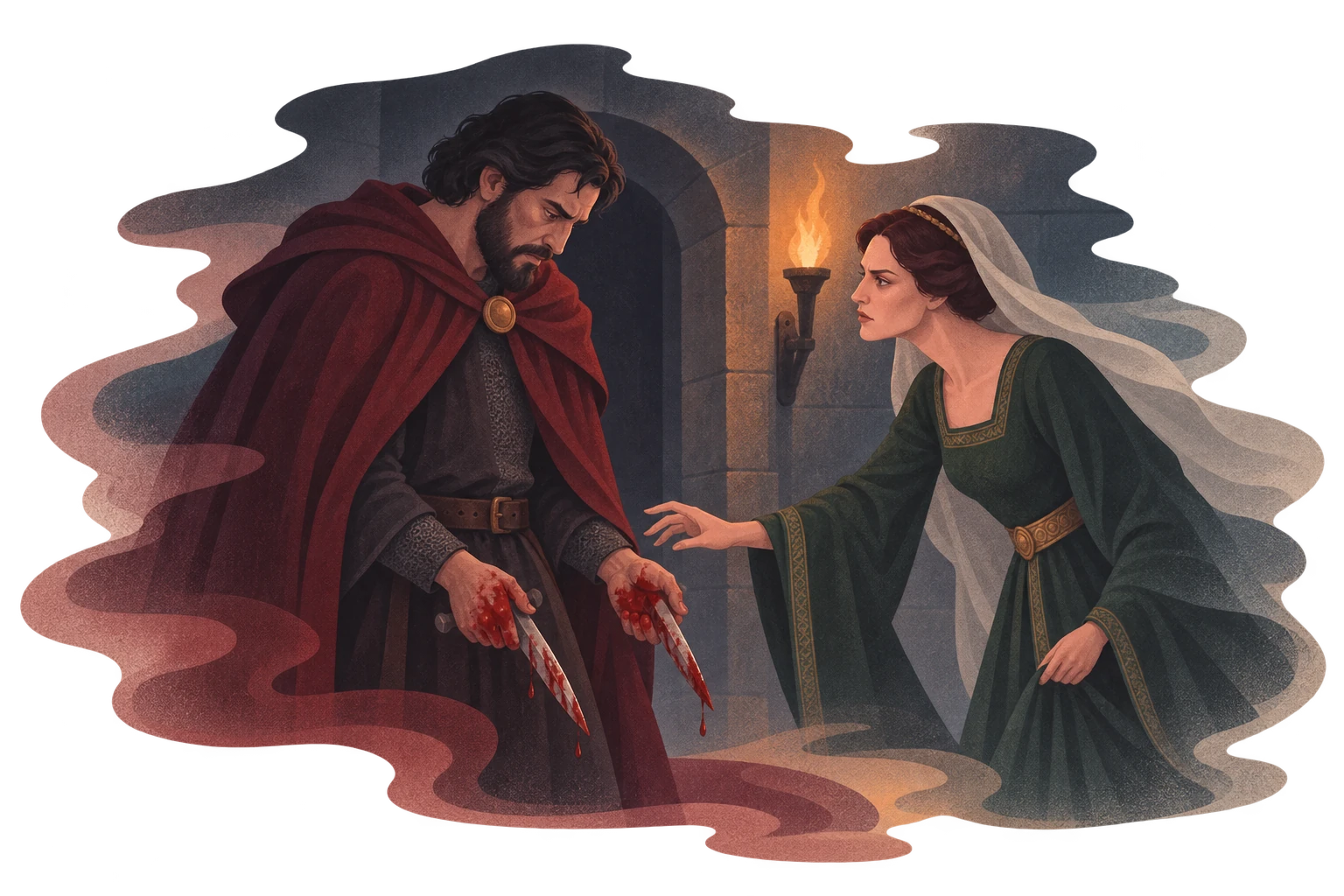
Macbeth’s historical wife was named Gruoch. However, there is no reliable evidence that she drove him to murder Duncan as Lady Macbeth does in the play. Lady Macbeth’s attack on her husband’s courage — ‘When you durst do it, then you were a man’ (Act 1, Scene 7) — belongs to Shakespeare’s dramatic portrayal, not an established record of their marriage.
Banquo and Fleance also need caution: their existence is not securely established by historical evidence. Their story was important to the traditional ancestry claimed for the Stuart royal family, including James VI of Scotland, who became James I of England.
The witches’ prophecies, Banquo’s ghost and Lady Macbeth’s sleepwalking should likewise be discussed as elements of the play, not evidence about the real Macbeth.
Why the differences matter in an essay
Historical context is most useful when it helps explain Shakespeare’s dramatic choices. Simply stating that Macbeth existed adds little to an essay about ambition or kingship. Explaining how Shakespeare transforms his story gives you an argument.
For example, Macbeth identifies his motive as ‘Vaulting ambition’ (Act 1, Scene 7). Because Shakespeare makes Duncan’s death a planned murder rather than a battlefield killing, the audience watches Macbeth knowingly choose wrongdoing. His later fear and violence develop from that choice.
The ending also changes history. In the play, Macduff kills Macbeth, and Malcolm’s final speech announces his accession and invites the nobles to his coronation at Scone (Act 5, Scene 8). Historically, Malcolm killed Macbeth, and Lulach ruled between them.
A useful essay claim is: Shakespeare reshapes the historical Macbeth’s rise and fall to present tyranny as a consequence of ambition without moral restraint. Support that claim with close analysis of the play, rather than treating historical background as a substitute for textual evidence.
Questions
Did the real Macbeth murder King Duncan?
Duncan I died in battle against Macbeth in 1040, rather than being secretly murdered as a sleeping guest. Shakespeare changes this into a deliberate betrayal of a king, relative and guest, making Macbeth’s decision central to the tragedy’s treatment of ambition and conscience.
Was Lady Macbeth a real person?
Macbeth had a historical wife named Gruoch, but Shakespeare’s Lady Macbeth is not a documented portrait of her. There is no reliable evidence that Gruoch urged Macbeth to murder Duncan. The character’s persuasion, guilt and sleepwalking belong to the play’s dramatic story.
Who killed the real Macbeth?
The historical Macbeth was killed by Malcolm, Duncan’s son, at Lumphanan in 1057. In Shakespeare’s play, Macduff kills him in Act 5, Scene 8. History also includes the brief reign of Macbeth’s stepson Lulach before Malcolm became king in 1058.
Is Shakespeare’s Macbeth historically accurate?
Only in broad outline. Macbeth and Duncan were real Scottish kings, and Malcolm eventually gained the throne. However, Shakespeare changes the circumstances of Duncan’s death, Macbeth’s defeat and the succession. The play is a tragedy shaped from historical and legendary material, not a factual account.