Who Is Malcolm in Macbeth?
Malcolm in Macbeth is King Duncan’s elder son, Donalbain’s brother and the rightful heir to Scotland’s throne. After Macbeth murders Duncan, Malcolm escapes to England. He later leads an army against Macbeth, with English and Scottish support, and is recognised as Scotland’s king after Macduff kills the tyrant.
Who is Malcolm in Macbeth?
Malcolm is Duncan’s elder son and chosen successor. He is not Macbeth’s son, and he is a different character from Macduff, the Scottish nobleman who eventually kills Macbeth.
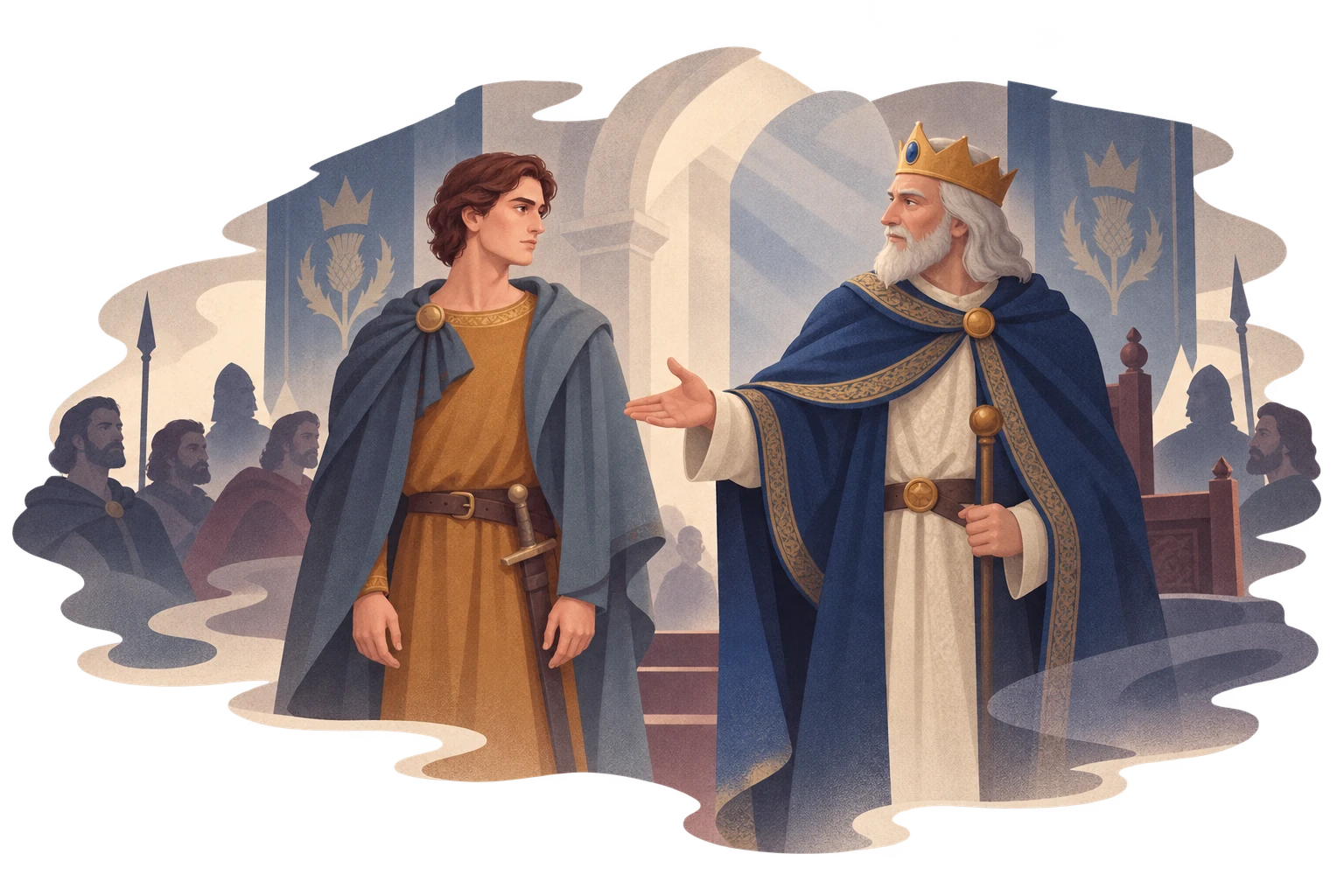
In Act 1, Scene 4, Duncan formally names Malcolm ‘The Prince of Cumberland’, establishing him as heir. This makes Malcolm an immediate obstacle to Macbeth’s ambition: the witches have predicted that Macbeth will become king, but Duncan has publicly identified someone else as his successor.
Macbeth describes Malcolm as ‘a step’ in his way (Act 1, Scene 4). The image reveals how ambition changes his view of other people: Duncan’s son becomes something to overcome rather than someone whose rights he should respect.
Malcolm therefore matters before he takes much action himself. His position makes the conflict over kingship and succession clear. Macbeth does not simply fill an empty throne after Duncan’s death; he takes power despite the existence of Duncan’s named heir.
Why Malcolm escapes to England
After Duncan’s murder is discovered in Act 2, Scene 3, Malcolm and his younger brother, Donalbain, fear that they may be the next targets. They cannot tell which apparently loyal people around them are trustworthy. Malcolm decides to go to England, while Donalbain leaves for Ireland.
Malcolm explains his suspicion through the contrast between outward behaviour and hidden intentions:
‘To show an unfelt sorrow is an office / Which the false man does easy.’ (Act 2, Scene 3)
His point is that a murderer can easily pretend to grieve. This connects his escape to the play’s theme of appearance versus reality: public displays of loyalty prove very little.
Their departure protects them, but it also has a political cost. In Act 2, Scene 4, Macduff reports that their flight has made them suspects in their father’s murder. Malcolm’s absence helps leave the way open for Macbeth to become king. His escape is therefore both a sensible act of survival and a decision with dangerous consequences.
Malcolm’s test of Macduff
In Act 4, Scene 3, Malcolm tests Macduff, who has come to England seeking help against Macbeth. Malcolm fears that Macduff might be working for the tyrant and trying to lure him into danger.
To discover Macduff’s true priorities, Malcolm falsely claims to possess overwhelming lust, greed and none of the ‘king-becoming graces’ (Act 4, Scene 3). He presents himself as someone who would govern even worse than Macbeth. Macduff eventually rejects him as unfit to rule and mourns Scotland’s prospects. This response convinces Malcolm that Macduff cares about the country rather than simply supporting anyone who might gain power.
The scene shows caution learned through betrayal. Duncan trusted Macbeth and was murdered; Malcolm refuses to assume that an apparently loyal visitor is trustworthy.
It also defines good kingship. Malcolm’s list includes ‘justice, verity, temperance, stableness’ (Act 4, Scene 3), presenting moral self-control and honesty as qualities a ruler needs. He then withdraws his false claims and accepts Macduff as an ally.
Malcolm’s victory and Scotland’s restoration
Malcolm returns to Scotland with English military support and joins the Scottish nobles resisting Macbeth. In Act 5, Scene 4, he orders each soldier to carry a branch cut from Birnam Wood, concealing the army’s numbers. This practical military tactic fulfils the witches’ apparently impossible prediction that the wood will come to Dunsinane.
Malcolm leads the campaign, but Macduff kills Macbeth. Keeping those roles separate is important: Malcolm is the heir who becomes king, while Macduff personally confronts and defeats the tyrant.
After Macbeth’s death, Macduff hails Malcolm as king. Malcolm’s final speech promises rewards for his supporters, the return of exiles and action against the agents of Macbeth’s tyranny. He invites everyone to see him crowned at Scone (Act 5, Scene 8).
For an essay, Malcolm works as a contrast to Macbeth: his claim rests on legitimate succession, and his closing promises concern repairing Scotland rather than satisfying private ambition. The ending offers the prospect of restored order, although the play ends before his reign unfolds.
Questions
Is Malcolm related to Macbeth?
Malcolm is Duncan’s elder son, not Macbeth’s son or brother. Duncan refers to Macbeth as his cousin in Act 1, Scene 4, indicating a family connection, but the play does not specify Malcolm’s exact relationship to Macbeth. Malcolm’s clearly established family relationships are with Duncan and Donalbain.
Does Malcolm kill Macbeth?
No. Macduff kills Macbeth in Act 5, Scene 8. Malcolm leads the forces opposing Macbeth and becomes king after his defeat. Their names can be easy to confuse, but their roles are distinct: Macduff defeats the tyrant in combat; Malcolm succeeds him as ruler.
Why does Malcolm lie to Macduff?
Malcolm lies to test whether Macduff genuinely cares about Scotland. In Act 4, Scene 3, he pretends he would be a vicious and corrupt king. When Macduff rejects him as unfit to rule, Malcolm recognises that Macduff’s loyalty is to Scotland, not merely to a possible future ruler.
How does Malcolm represent good kingship?
Malcolm identifies justice, truthfulness and self-control as essential royal qualities in Act 4, Scene 3. His final speech promises to reward loyalty and address the damage caused by Macbeth. He represents the possibility of responsible government, although Shakespeare does not show his actual reign.