Where Is Macbeth Set?
Macbeth is set mainly in eleventh-century Scotland, with one scene at the English court. Important locations include Macbeth’s castle at Inverness, where Duncan is murdered, and Dunsinane, Macbeth’s stronghold at the end. Nearby Birnam Wood becomes central to his defeat. The play draws loosely on medieval Scottish history.
Where is Macbeth set? The main Scottish locations
The action moves between several Scottish locations rather than staying in one castle. The most important places to distinguish are Inverness, the setting for Duncan’s murder, and Dunsinane, Macbeth’s stronghold during the final attack.
- Inverness: Macbeth and Lady Macbeth welcome Duncan into their home in Act 1, Scene 6. Macbeth murders him there in Act 2, Scene 2.
- Forres: Duncan’s court is located here early in the play. It is also the setting conventionally identified for Macbeth’s royal palace in Act 3.
- Fife: Macduff’s household is attacked here in Act 4, Scene 2. The murder of his family shows Macbeth’s violence reaching beyond his immediate rivals.
- Dunsinane: Macbeth prepares to resist Malcolm’s forces here in Act 5.
Other places are mentioned without becoming major settings. In Act 2, Scene 4, Macduff reports that Macbeth has gone to Scone to be invested as king. Shakespeare does not stage that ceremony.
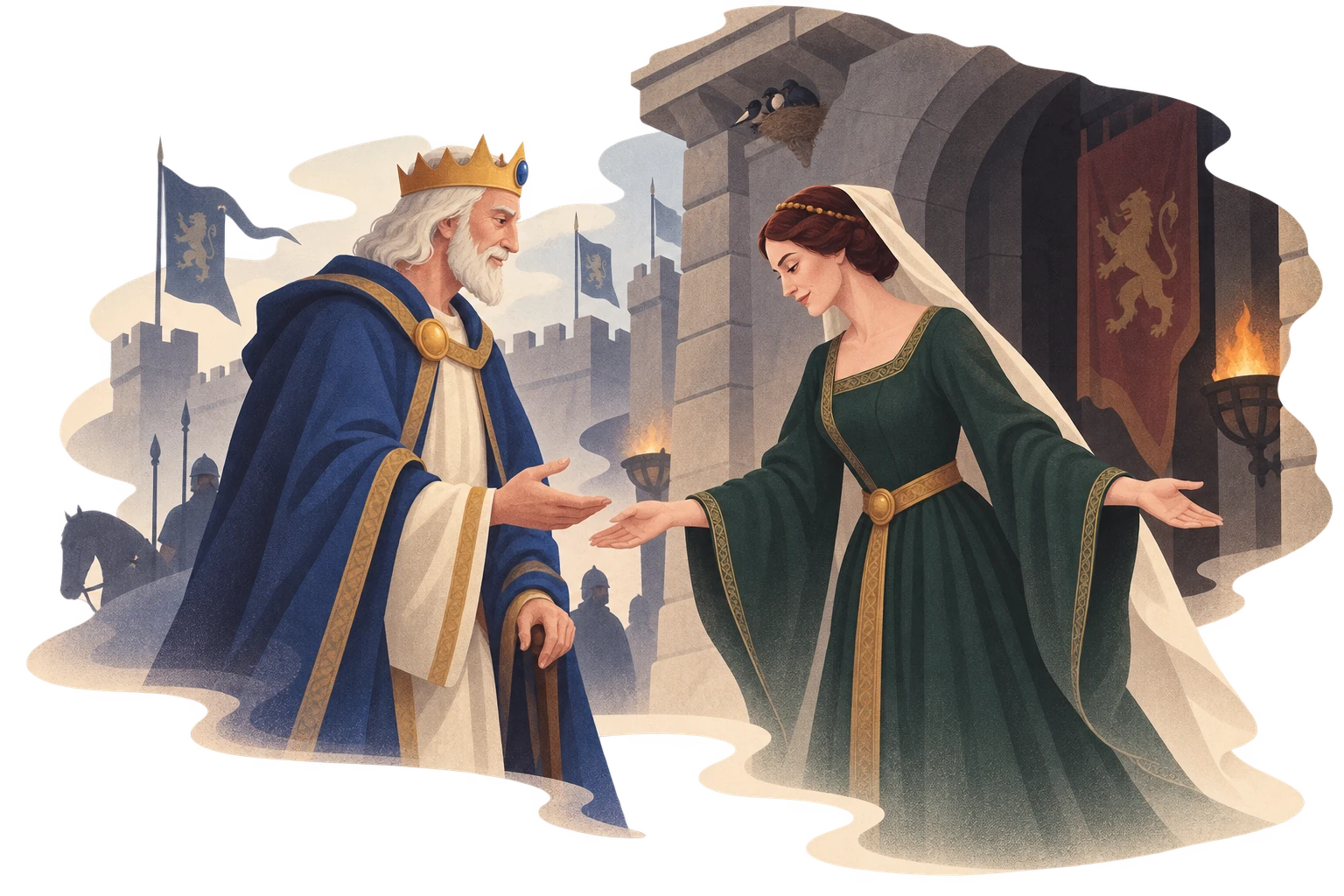
The heath, Birnam Wood and Dunsinane
The outdoor settings connect Scotland’s landscape with uncertainty and danger. In Act 1, Scene 1, the witches agree to meet Macbeth ‘Upon the heath’. This exposed place contrasts with the supposedly secure world of castles and royal courts. Their encounter with Macbeth and Banquo in Act 1, Scene 3 brings supernatural temptation into the political story.
Birnam Wood becomes crucial through the apparitions’ prediction in Act 4, Scene 1. Macbeth believes he cannot be defeated until the wood comes to Dunsinane, something he treats as impossible.
In Act 5, Scene 4, Malcolm orders each soldier to carry a branch to conceal the army’s numbers. When the soldiers advance, the wood appears to move. The landscape therefore helps expose Macbeth’s mistaken confidence: the prophecy comes true, but not in the way he imagined.
For analysis, connect these settings to appearance versus reality. Macbeth sees the natural world as a guarantee of safety, while his enemies turn it into a disguise.
The scene in England
Although Scotland dominates the play, Act 4, Scene 3 takes place in England, at the court of Edward the Confessor. Malcolm has taken refuge there after Duncan’s murder, and Macduff comes to seek help against Macbeth.
This scene widens the play’s political perspective. Scotland is suffering under Macbeth, while England offers shelter and military support to those opposing him. Malcolm tests Macduff’s loyalty before trusting him, making the English setting a place where Scotland’s future government is debated and its restoration prepared.
The contrast also develops the theme of kingship. Edward is associated with healing, whereas Macbeth’s rule brings suffering to his country. Shakespeare presents the effects of a ruler’s character as extending throughout the nation.
England is therefore more than a place of escape. It provides the support that allows Malcolm and Macduff to return to Scotland and challenge Macbeth.
When Macbeth is set and why it matters
Macbeth is set broadly in eleventh-century Scotland. The historical Macbeth ruled from 1040 to 1057, but Shakespeare’s play is not an accurate reconstruction of his reign. It reshapes historical material into a tragedy about ambition, murder and political collapse. Those dates provide background, not a precise timetable for every event on stage.
The medieval setting makes relationships between king, nobles, hosts and guests especially important. Macbeth owes Duncan loyalty as his subject and protection as his host. Killing him at Inverness violates both obligations.
Shakespeare sharpens that betrayal through the castle’s welcoming appearance. Arriving at Inverness, Duncan says, ‘This castle hath a pleasant seat’ (Act 1, Scene 6). The audience already knows that Lady Macbeth intends his death, so his praise creates dramatic irony.
A useful essay argument is that the settings trace the spread of Macbeth’s violence: a murder inside his own home develops into suffering across Scotland, before an army closes in on his final stronghold.
Questions
Is Macbeth set in Scotland or England?
Macbeth is set mainly in Scotland. The exception is Act 4, Scene 3, which takes place at the English court. There, Malcolm tests Macduff’s loyalty and they discuss English support for the campaign to remove Macbeth from power.
Which castle is Duncan murdered in?
Duncan is murdered in Macbeth’s castle at Inverness in Act 2, Scene 2. He is staying there as Macbeth and Lady Macbeth’s guest. Do not confuse Inverness with Dunsinane, the stronghold Macbeth defends in the final act.
Is Macbeth set in the time Shakespeare lived?
No. The action belongs to medieval Scotland, broadly the eleventh century, rather than Shakespeare’s own lifetime. The play was written around 1606. Distinguish its historical setting from its context of composition: Shakespeare uses an earlier Scottish story to explore concerns relevant to his audience.
Does Birnam Wood really move?
The trees do not uproot themselves or move supernaturally. In Act 5, Scene 4, Malcolm tells his soldiers to carry branches as camouflage. Their advance makes Birnam Wood appear to approach Dunsinane, fulfilling the prediction in a way Macbeth failed to anticipate.