Who Is Banquo in Macbeth?
Banquo in Macbeth is a Scottish general, Macbeth’s friend and fellow soldier, and the father of Fleance. The witches predict that his descendants will become kings. Unlike Macbeth, he does not commit murder to pursue their promises. Macbeth later orders his killing, and Banquo’s ghost appears at the royal banquet.
Banquo in Macbeth: soldier, friend and father
Banquo begins as Macbeth’s fellow general in the service of King Duncan. Both men fight for Scotland, and both encounter the witches after the battle in Act 1, Scene 3. Their shared position makes the difference between their later choices especially important: Macbeth is not the only brave soldier exposed to supernatural temptation.
Banquo is also the father of Fleance. This relationship becomes central because the witches promise kingship to Banquo’s descendants, not to Banquo himself. Macbeth comes to see his former companion as a threat to the future of his royal line.
Banquo therefore has two main dramatic roles. As Macbeth’s foil, or contrasting character, he shows a different response to prophecy. As Fleance’s father, he represents a future Macbeth cannot control. His importance is not simply that he is a good man whom Macbeth kills: his presence exposes Macbeth’s growing willingness to betray friendship and loyalty for power.
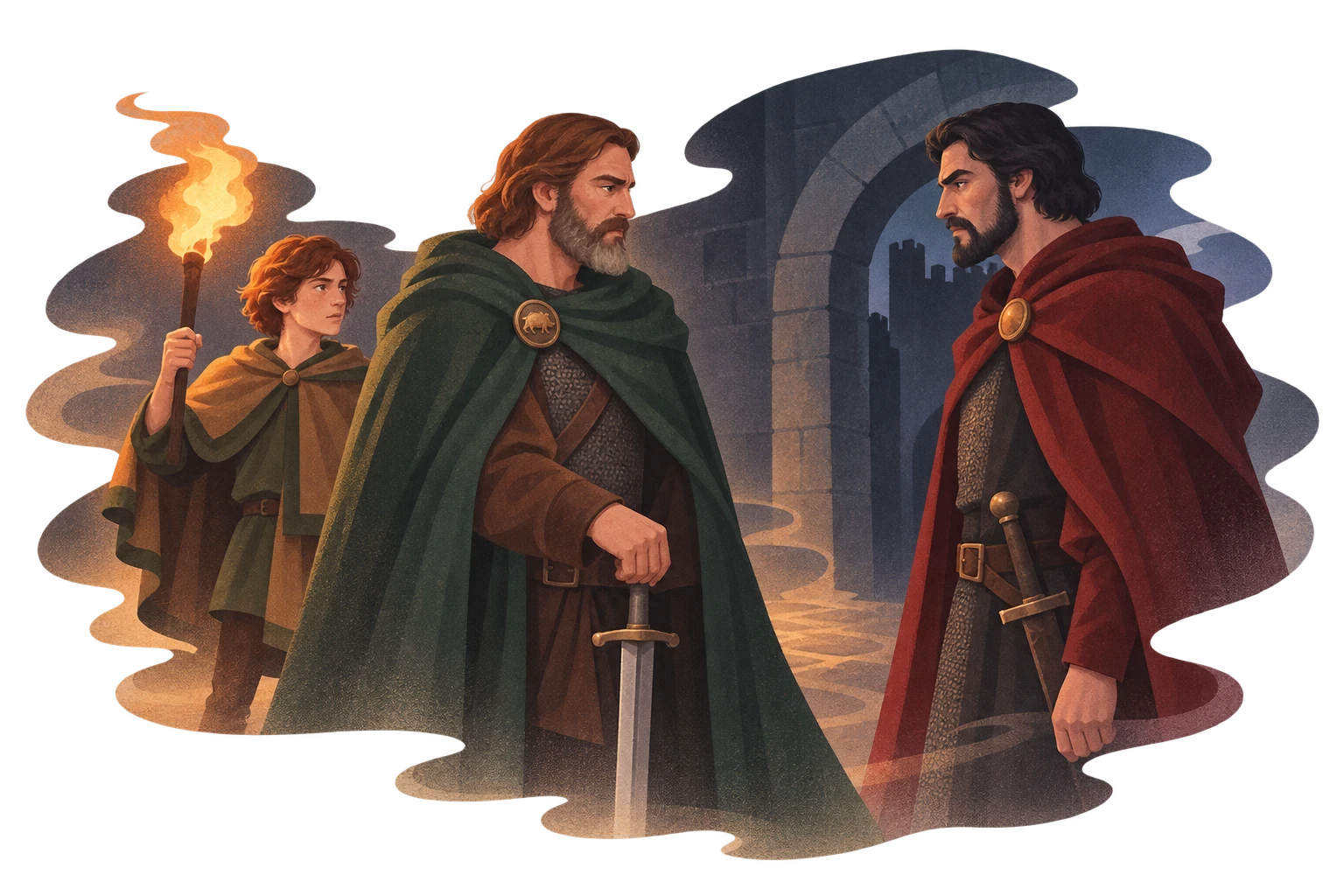
Banquo’s response to the witches
The witches tell Banquo that he will be ‘Lesser than Macbeth, and greater’ and ‘Not so happy, yet much happier’ (Act 1, Scene 3). These paradoxes separate immediate success from lasting worth. Macbeth will gain the crown, but Banquo will avoid his companion’s murderous route to power and is promised a royal line.
Banquo recognises that supernatural promises can be dangerous. He warns that ‘the instruments of darkness tell us truths’ (Act 1, Scene 3). His point is that an accurate prediction does not make its source trustworthy: small truths may encourage someone towards much greater harm.
However, Banquo is not completely untouched by temptation. He asks the witches about his own future, and later wonders whether their promises might also benefit him (Act 3, Scene 1). This makes him a more convincing contrast to Macbeth. Both men feel the attraction of prophecy, but Banquo does not turn that attraction into a plan to kill. Shakespeare presents temptation and action as different things.
Why Macbeth has Banquo murdered
By Act 3, Scene 1, Banquo suspects that Macbeth has gained the throne dishonestly: ‘I fear, / Thou play’dst most foully for’t’. His suspicion makes him dangerous to a king whose authority depends on concealing murder. Yet the play does not show Banquo publicly accusing Macbeth or organising resistance against him.
Macbeth also fears Banquo’s courage, judgement and promised descendants. He admits, ‘Our fears in Banquo / Stick deep’ (Act 3, Scene 1). Having murdered Duncan to become king, Macbeth cannot bear the thought that Banquo’s family might inherit the benefits. His ambition now reaches beyond possessing the crown to controlling the succession.
Macbeth hires murderers to attack both Banquo and Fleance. In Act 3, Scene 3, Banquo is killed, but urges his son to escape: ‘Fly, good Fleance, fly, fly, fly!’ Fleance survives. The murder therefore fails to secure Macbeth’s future: it destroys a friendship without removing the possibility that the witches’ prediction will come true.
Banquo’s ghost and his lasting importance
Banquo returns as a ghost at Macbeth’s banquet in Act 3, Scene 4. Macbeth reacts with terror, while the guests cannot see what is disturbing him. His protest, ‘Thou canst not say I did it’, exposes his defensive thinking: although he did not personally strike Banquo, he ordered the murder.
The ghost can be read as a supernatural visitation, a dramatic expression of Macbeth’s guilt, or both. Its appearance turns a public display of royal authority into disorder. Macbeth can arrange a killing, but he cannot control its psychological consequences or keep his behaviour convincing before the nobles.
Banquo’s significance continues in Act 4, Scene 1, when the witches show Macbeth a line of kings associated with Banquo. This vision renews Macbeth’s fear that he has gained power for another family’s benefit. The play does not show Fleance becoming king: Malcolm takes the throne at the end. Banquo’s promised dynasty remains a future beyond the action, not an event the audience witnesses.
Questions
Is Banquo related to Macbeth?
The play presents Banquo as Macbeth’s fellow general and friend, not as his brother or another identified relative. Their bond comes from military service and their shared encounter with the witches. Fleance is Banquo’s son, not Macbeth’s.
Is Banquo a good character?
Banquo is generally presented as honourable, brave and more cautious than Macbeth. However, he is interested in the witches’ promises and does not publicly challenge Macbeth despite suspecting wrongdoing. It is more accurate to call him a moral contrast to Macbeth than a completely flawless character.
What do the witches predict for Banquo?
The witches predict that Banquo will not be king himself, but that his descendants will be kings (Act 1, Scene 3). This promise makes him and Fleance threatening to Macbeth. Fleance escapes the murderers, but the play ends before showing the promised dynasty established.
Does Macbeth kill Banquo himself?
No. Macbeth hires murderers to kill Banquo and Fleance in Act 3, Scene 1. The attack happens in Act 3, Scene 3: Banquo dies, while Fleance escapes. Macbeth remains responsible because he orders the attack, even though he is not present.