Who Is Macduff in Macbeth?
Macduff in Macbeth is the Thane of Fife, a Scottish nobleman who discovers King Duncan’s murder and later opposes Macbeth’s rule. After Macbeth orders the slaughter of his family, Macduff helps Malcolm reclaim Scotland. He kills Macbeth in their final fight, fulfilling the witches’ misleading prophecy about Macbeth’s safety.
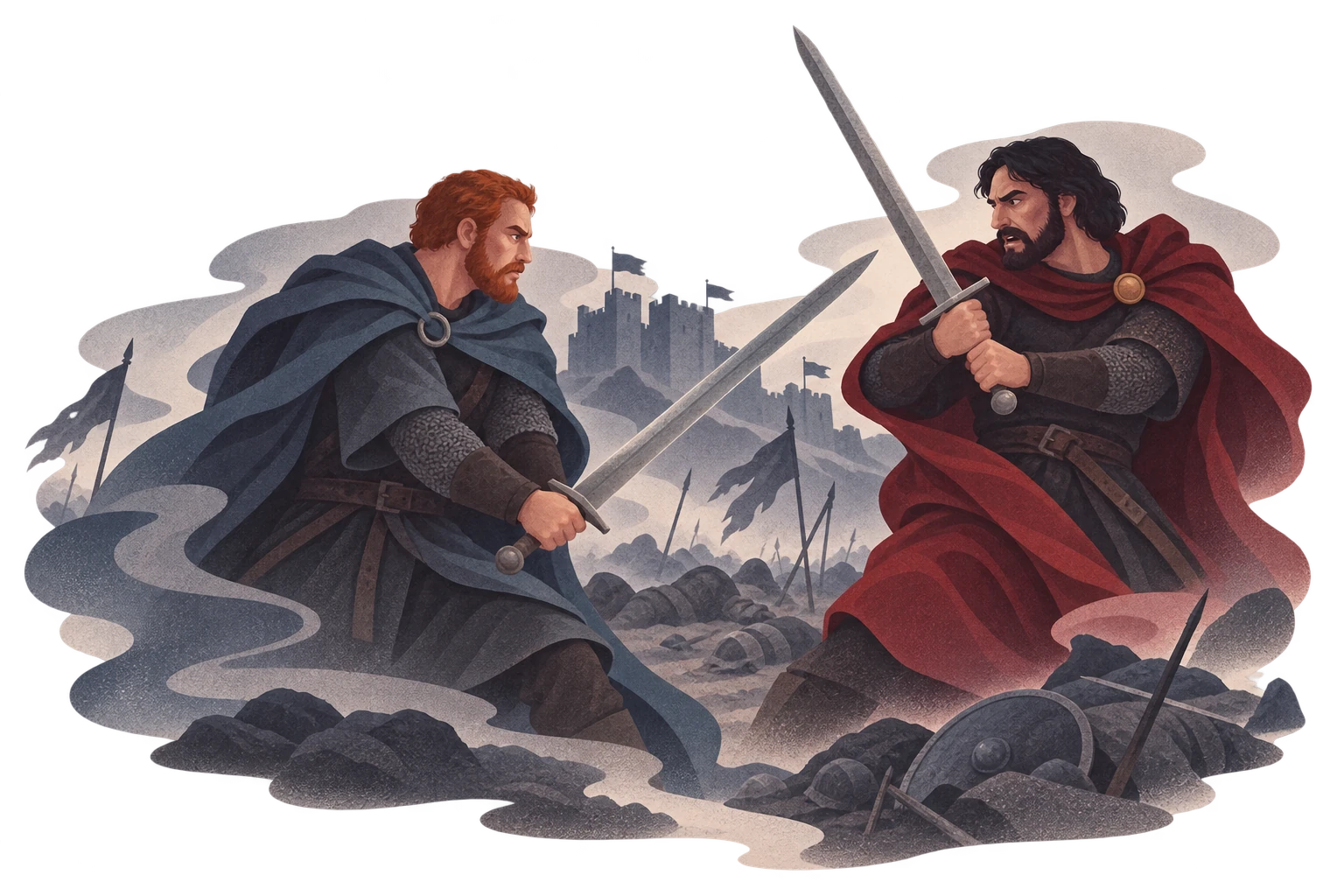
Macduff in Macbeth: loyalty and resistance
Macduff is the Thane of Fife: a Scottish nobleman with authority over Fife. He initially serves King Duncan, then becomes an important opponent of Macbeth’s tyranny. Unlike Macbeth, he does not seek the crown for himself. He supports Duncan’s son Malcolm as Scotland’s rightful king.
His first major action is discovering Duncan’s murdered body in Act 2, Scene 3. His cry, ‘O horror, horror, horror!’, expresses the shock of finding his king killed. It also contrasts with Macbeth’s performance of innocence: Macduff responds to a crime that Macbeth has secretly committed.
In Act 2, Scene 4, Macduff says he will return to Fife rather than attend Macbeth’s coronation at Scone. This distances him from the new king, although he does not yet openly accuse Macbeth of murder. His resistance develops as the play continues. Shakespeare makes him a measure of loyalty directed towards Scotland and its rightful ruler, rather than towards whoever happens to hold power.
Why Macduff goes to England
Macduff travels to England to seek help against Macbeth and support Malcolm. His opposition is therefore political before it becomes a matter of personal revenge. In Act 4, Scene 3, his appeal, ‘Bleed, bleed, poor country!’, presents Scotland as a wounded body suffering under its ruler.
Malcolm does not immediately trust him. He fears that Macduff might be working for Macbeth, so he tests him by pretending to possess qualities that would make him a terrible king. Macduff’s despair at this supposed confession helps convince Malcolm that his concern for Scotland is genuine.
However, leaving Scotland has a terrible cost. Macduff leaves his wife and children behind, and Lady Macduff condemns his departure in Act 4, Scene 2. She cannot understand why a husband and father would leave his household exposed to danger.
This tension prevents Macduff from becoming a faultless hero. His public duty is honourable, but the play also asks what happens when service to a country conflicts with responsibility towards a family.
His family’s murder and his response to grief
After learning that Macduff has fled to England, Macbeth orders an attack on his castle in Act 4, Scene 1. The following scene shows the murderers attacking Macduff’s household. Ross later tells Macduff that his wife and children have been killed.
The slaughter demonstrates Macbeth’s tyranny: he targets a defenceless family because he cannot reach his political opponent. It also makes Macduff’s struggle painfully personal. He blames himself for being absent, even though Macbeth bears responsibility for ordering the killings.
When Malcolm urges him to respond like a man, Macduff answers, ‘I must also feel it as a man’ (Act 4, Scene 3). He does not reject courage or action; he rejects the idea that manhood requires emotional numbness.
This makes him an important contrast to Macbeth, whose masculinity Lady Macbeth earlier associates with a willingness to kill. For an essay, explain that Macduff offers an alternative: grief, love and tenderness can coexist with courage. His revenge grows from human attachment, not ambition for power.
How Macduff kills Macbeth
In Act 5, Scene 8, Macduff confronts Macbeth in the final battle. Macbeth believes himself protected by the apparition’s assurance that ‘none of woman born’ will harm him (Act 4, Scene 1). He assumes this means no human opponent can kill him.
Macduff reveals that he was removed from his mother’s womb before a natural birth. The play treats this unusual birth as the exception to the apparition’s wording. Macbeth’s confidence collapses because the prediction was equivocal: its words concealed a meaning he had not considered.
Macduff then kills Macbeth and presents his severed head to Malcolm. He does not become king himself. Instead, he hails Malcolm as king, helping restore the succession disrupted by Duncan’s murder.
His final role brings together personal revenge and national liberation. Yet Shakespeare does not simply oppose violent Macbeth to peaceful Macduff: both are warriors. The crucial distinction is the purpose of their violence—Macbeth kills to seize and preserve power, while Macduff fights to end his tyranny.
Questions
Is Macduff related to Macbeth?
The play does not identify Macduff as a close relative of Macbeth. They are both Scottish noblemen, but they are different characters with different titles: Macduff is Thane of Fife, while Macbeth becomes Thane of Cawdor and then king.
Why does Macbeth kill Macduff’s family?
Macbeth orders the attack after learning that Macduff has fled to England in Act 4, Scene 1. Unable to strike directly at Macduff, he targets his household. This punishes opposition through violence against innocent people and shows how far Macbeth has developed into a tyrant.
Was Macduff born by Caesarean section?
That is the usual modern explanation of Macduff’s birth. In Act 5, Scene 8, he says he was removed from his mother’s womb prematurely. The play gives no further medical detail. His birth defeats Macbeth’s assumption that the prophecy protects him against every possible human opponent.
How is Macduff a foil to Macbeth?
A foil is a character whose differences help reveal another character’s qualities. Macduff supports Malcolm rather than seeking kingship, and openly mourns his family rather than treating emotion as weakness. These contrasts expose Macbeth’s selfish ambition and challenge the idea that masculinity depends on emotional hardness.