What Year Was Macbeth First Performed?
Macbeth was probably first performed in 1606, although its exact first performance date is unknown. The earliest surviving eyewitness account records a performance at the Globe Theatre on 20 April 1611. For schoolwork, give 1606 as the likely year, but distinguish it from the first documented performance.
What year was Macbeth first performed?
1606 is the usual answer, but it is an estimated date rather than a securely documented première. Scholars generally place the writing of Macbeth around 1606, and its first performances are commonly assigned to the same period. No surviving record establishes exactly when or where the play was first staged.
One reason for this dating is the play’s apparent connection with events and concerns from the early reign of James I. The Gunpowder Plot of 1605 had made treason against a king an especially urgent subject. The Porter’s reference to an ‘equivocator’ in Act 2, Scene 3 is often linked to contemporary arguments about deceptive or evasive language, particularly those surrounding the Jesuit Henry Garnet’s trial in 1606.
These connections help explain the accepted date, but they do not prove a particular opening night. The most accurate short formulation is therefore: Macbeth was probably first performed in 1606, rather than definitely first performed on a known date that year.
The first recorded performance: 20 April 1611
The earliest surviving eyewitness account of a performance of Macbeth comes from Simon Forman, an astrologer and medical practitioner. He recorded seeing the play at the Globe Theatre on 20 April 1611. His account describes recognisable elements of the story, including the witches’ predictions and Macbeth’s rise to power.
This is evidence that the play was being performed by that date. It is not evidence that the performance Forman attended was its first. A surviving account tells us what one spectator saw; it does not provide a complete history of earlier productions.
The distinction matters because first performed and first recorded performance are not interchangeable. Many theatrical events left no surviving documentation, so the earliest record we possess may describe a play that audiences already knew.
If two sources give 1606 and 1611, they may therefore be answering different questions. 1606 is the probable date of the play’s first staging; 20 April 1611 is the date attached to its earliest surviving eyewitness account.
Why the 1606 context matters when reading the play
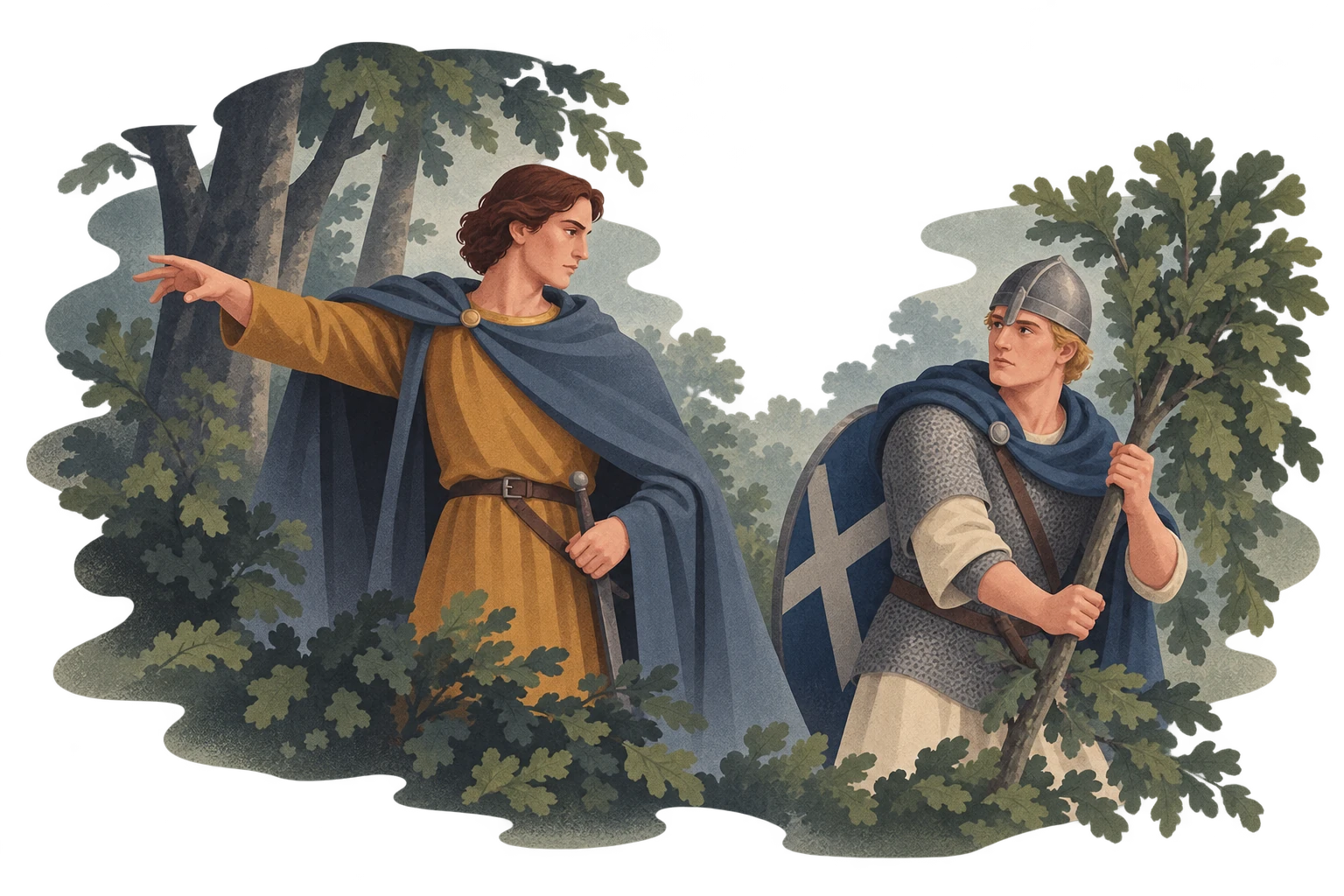
Dating Macbeth to around 1606 places it in Jacobean England, during the reign of James I, who was also James VI of Scotland. Its Scottish setting, threatened monarchy and supernatural predictions would all have had particular relevance in that political climate.
James had a strong interest in witchcraft and traced his ancestry to Banquo. The witches’ promise to Banquo, ‘Thou shalt get kings, though thou be none’ (Act 1, Scene 3), therefore gives the play’s concern with succession a connection to the reigning monarch. This does not prove that every detail was designed to flatter James, but it helps explain why Banquo’s descendants matter so much.
The play also explores the difference between legitimate kingship and tyranny. Macbeth gains the crown through murder, then uses further violence to protect it; Malcolm’s return offers the prospect of political recovery.
In an essay, connect context to a specific dramatic choice. Rather than simply mentioning James I, explain how the prophecy about Banquo makes royal inheritance central to Macbeth’s insecurity.
Questions
Was Macbeth first performed in 1606 or 1611?
1606 is the probable year of its first performance. 1611 is the year of the earliest surviving eyewitness account, written by Simon Forman after seeing it at the Globe. The dates refer to different kinds of evidence, so they are not necessarily contradictory.
Was Macbeth first performed for King James I?
It is often suggested that Macbeth was first performed for James I, but no surviving evidence securely establishes that claim. Its themes have clear connections with his reign. That makes a royal audience plausible, not a proven fact about the première.
When was Macbeth first published?
Macbeth was first published in 1623, in the collection of Shakespeare’s plays known as the First Folio. Publication came after Shakespeare’s death and years after the play was being performed. Its publication date should not be confused with its probable composition or first performance date.
Is Macbeth an Elizabethan or Jacobean play?
Macbeth is a Jacobean play because it is generally dated to around 1606, during James I’s reign. Shakespeare’s career spanned both Elizabeth I’s and James I’s reigns, but describing Macbeth specifically as Elizabethan gives it the wrong historical context.